What Is a Foundation Model?
Foundation models are among the most important innovations in modern artificial intelligence. They serve as the underlying technology behind many popular AI applications, including chatbots, AI writing assistants, image generators, coding assistants, search tools, and virtual assistants. Instead of building a separate AI system for every individual task, developers can create one powerful model that learns from massive amounts of data and adapts to many different applications.
As AI adoption continues to grow across industries, foundation models are helping businesses, researchers, educators, and software developers build intelligent applications more quickly and efficiently. These models can understand language, recognize images, generate content, write code, summarize documents, and perform many other tasks using a single underlying architecture.
Although foundation models are highly capable, they are designed to assist people rather than replace human expertise. Human oversight remains essential to verify outputs, make important decisions, and ensure AI is used responsibly.
What Is a Foundation Model?
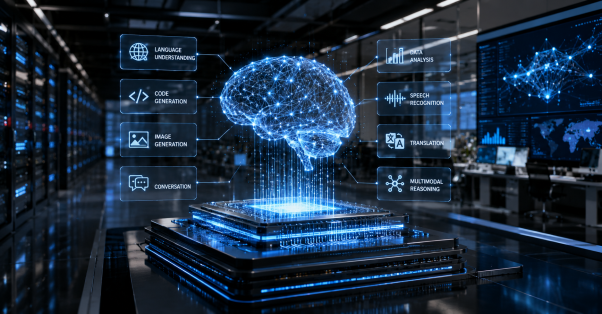
A foundation model is a large artificial intelligence model trained on enormous amounts of diverse data so it can perform a wide variety of tasks without being built specifically for each one.
Instead of training a separate model for writing, translation, image analysis, or coding, developers first train a foundation model on broad datasets. The model learns general patterns, relationships, and knowledge that can later be adapted—or fine-tuned—for specific industries or use cases.
Foundation models are the building blocks behind many modern AI systems, especially generative AI applications.
How Do Foundation Models Work?
Foundation models learn by processing vast collections of text, images, audio, video, or other data. During training, they identify patterns, relationships, and structures that help them understand and generate meaningful outputs.
Most modern language-based foundation models use transformer architectures that allow them to process large amounts of information efficiently and understand context across long passages of text.
After the initial training phase, organizations can customize foundation models for specific applications using additional training data, fine-tuning techniques, or carefully designed prompts.
Key Characteristics of Foundation Models
1. Large-Scale Training
Foundation models are trained using extremely large datasets collected from diverse sources, allowing them to learn general knowledge and language patterns.
2. Multiple Capabilities
A single foundation model can support many different tasks, including:
-
Text generation
-
Question answering
-
Translation
-
Summarization
-
Code generation
-
Image understanding
-
Content classification
3. Adaptability
Organizations can adapt foundation models for specialized industries such as healthcare, finance, education, manufacturing, legal services, and customer support without training a new model from scratch.
4. Transfer Learning
Knowledge gained during large-scale training can be reused across different tasks, reducing development time and improving efficiency.
5. Continuous Improvement
Foundation models can be updated, refined, and optimized as new data, techniques, and safety improvements become available.
Common Applications of Foundation Models
Foundation models support a wide range of AI-powered applications, including:
-
AI chatbots
-
Writing assistants
-
Search engines
-
Code generation tools
-
Image generation
-
Video generation
-
Language translation
-
Customer support automation
-
Document summarization
-
Research assistance
-
Data analysis
-
Virtual assistants
Benefits of Foundation Models
Greater Versatility
One model can perform multiple tasks, reducing the need to develop separate AI systems for every application.
Faster AI Development
Developers can build AI-powered products more quickly by adapting existing foundation models instead of creating models from the ground up.
Improved Productivity
Foundation models help automate repetitive tasks such as drafting documents, summarizing information, generating code, and organizing data.
Broad Knowledge Base
Training on diverse datasets enables foundation models to understand many topics and respond to a wide range of requests.
Scalability
The same foundation model can support applications across different industries and business functions.
Challenges of Foundation Models
Accuracy
Foundation models may generate incorrect or outdated information. Users should verify important facts before relying on AI-generated content.
Bias
Training data may contain biases that influence model outputs. Developers work to reduce these risks through testing and responsible AI practices.
High Computing Requirements
Training and operating large foundation models require significant computing power, storage, and energy resources.
Privacy and Security
Organizations should ensure that sensitive information is handled responsibly and protected through appropriate security measures.
Human Oversight
Foundation models should support human decision-making rather than replace professional expertise, particularly in high-stakes fields.
Best Practices for Using Foundation Models
Use Human Review
Always review AI-generated content before publishing or making important decisions.
Choose the Right Model
Select a foundation model that matches your specific business or technical requirements.
Protect Sensitive Data
Avoid sharing confidential or personal information unless appropriate safeguards are in place.
Write Clear Prompts
Well-structured prompts often produce more accurate and useful results.
Monitor Performance
Regularly evaluate outputs for quality, fairness, and reliability, and update workflows as AI capabilities evolve.
Future of Foundation Models
Foundation models are expected to become more capable, efficient, and specialized over the coming years. Advances in model architecture, computing hardware, and training methods may improve reasoning, multilingual capabilities, multimodal understanding, and domain-specific performance.
Businesses are increasingly developing customized foundation models tailored to industries such as healthcare, finance, education, manufacturing, and scientific research. These specialized models can provide more relevant insights while meeting industry-specific requirements.
Responsible AI development will continue to play a central role. Researchers and technology companies are investing in improving transparency, reducing bias, strengthening security, and building governance frameworks that encourage safe and ethical AI adoption.
Rather than replacing human expertise, foundation models are likely to become trusted assistants that enhance productivity, support creativity, and help professionals solve increasingly complex problems.
Conclusion
Foundation models have become the foundation of modern artificial intelligence by providing a flexible platform that supports a wide variety of AI applications. Their ability to learn from large datasets and adapt to different tasks has accelerated innovation across industries and made advanced AI more accessible.
As organizations continue adopting AI, foundation models will remain central to developing intelligent applications that improve efficiency, automate routine work, and support better decision-making. Their success, however, depends on responsible use, high-quality data, strong security practices, and meaningful human oversight.
When combined with human expertise, foundation models can enhance productivity, encourage innovation, and unlock new opportunities across business, education, healthcare, research, and many other fields.