What Is a Diffusion Model? A Simple Guide
Artificial Intelligence (AI) has introduced new ways to create images, artwork, videos, and digital content. One of the most significant breakthroughs behind many modern AI image generators is the diffusion model. These models have become the foundation of many creative AI tools, enabling users to generate realistic images from simple text descriptions.
Diffusion models are now widely used by designers, marketers, developers, researchers, educators, and content creators to produce high-quality visuals quickly. They help generate illustrations, product designs, concept art, marketing graphics, and much more. Rather than replacing human creativity, diffusion models act as intelligent creative assistants that help users transform ideas into visual content more efficiently.
Although diffusion models are highly advanced, they rely on human guidance through prompts, editing, and review. Human creativity, artistic judgment, and responsible use remain essential when creating AI-generated content.
What Is a Diffusion Model?
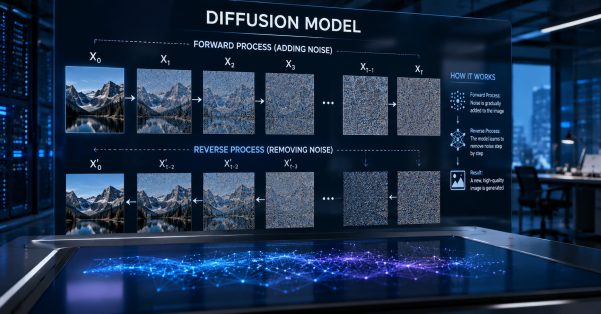
A diffusion model is a type of artificial intelligence model designed to generate new content—most commonly images—by learning how to gradually remove noise from random data until a clear and meaningful result is produced.
During training, the model learns what happens when noise is progressively added to images. Once trained, it performs the reverse process by starting with random noise and gradually removing it step by step until it creates a realistic image that matches a user's prompt or input.
Because of this process, diffusion models can generate highly detailed and visually convincing images across many different styles and subjects.
How Do Diffusion Models Work?
Diffusion models operate through two main stages.
1. Forward Diffusion (Adding Noise)
During training, the AI gradually adds random noise to millions of images until the original images become almost completely random.
This teaches the model how images change as increasing amounts of noise are introduced.
2. Reverse Diffusion (Removing Noise)
Once training is complete, the model performs the reverse process.
Starting with pure random noise, it removes small amounts of noise over many steps while following the user's text prompt or other input.
Eventually, a completely new image emerges that matches the requested description.
This gradual refinement process allows diffusion models to create detailed and realistic images.
Key Characteristics of Diffusion Models
1. High-Quality Image Generation
Diffusion models are capable of producing detailed, realistic, and visually appealing images with accurate textures, lighting, and composition.
2. Text-to-Image Generation
Users can describe an image using natural language, and the model generates artwork based on the prompt.
Examples include:
-
Landscapes
-
Portraits
-
Product concepts
-
Architectural designs
-
Marketing illustrations
-
Fantasy artwork
3. Image Editing
Many diffusion models can modify existing images by adding, removing, or replacing objects while preserving the original composition.
4. Style Transfer
Diffusion models can generate images in different artistic styles, such as watercolor, oil painting, anime, pencil sketches, realistic photography, or digital illustration.
5. Fine-Tuning and Customization
Organizations and developers can adapt diffusion models using specialized datasets to create images for particular industries, products, or creative workflows.
Common Applications of Diffusion Models
Diffusion models are increasingly used across many industries, including:
-
AI image generation
-
Digital artwork
-
Graphic design
-
Marketing content
-
Product visualization
-
Fashion design
-
Architecture concepts
-
Interior design
-
Game development
-
Film pre-production
-
Educational illustrations
-
Scientific visualization
Benefits of Diffusion Models
High Image Quality
Diffusion models can generate highly detailed visuals with realistic textures, lighting, and composition.
Creative Flexibility
Users can create a wide variety of visual styles simply by changing their prompts or editing instructions.
Faster Content Creation
AI reduces the time needed to produce concept art, marketing graphics, illustrations, and design prototypes.
Supports Creative Workflows
Designers and artists can use diffusion models to explore ideas, generate inspiration, and accelerate creative projects.
Broad Range of Applications
The same diffusion model can support multiple industries, including advertising, entertainment, education, architecture, and product design.
Challenges of Diffusion Models
Computing Requirements
Generating high-quality images often requires powerful graphics processors (GPUs) and significant computing resources.
Prompt Quality
The quality of generated images depends heavily on how clearly the user describes the desired result.
Copyright and Licensing
Users should understand the licensing terms of AI-generated images and respect intellectual property rights when creating or publishing content.
Bias
If training data contains biases, AI-generated images may reflect those biases. Developers work to reduce these issues through ongoing research and model improvements.
Human Oversight
AI-generated images should be reviewed for accuracy, quality, and appropriateness before professional or commercial use.
Best Practices for Using Diffusion Models
Write Detailed Prompts
Clear and descriptive prompts generally produce better image quality and more accurate results.
Review Every Image
Carefully examine generated images for errors, unrealistic details, or unintended content.
Respect Copyright
Use AI-generated images responsibly and verify licensing requirements when necessary.
Combine AI with Creativity
Treat diffusion models as creative assistants rather than replacements for artistic skills and professional judgment.
Continue Learning
Experiment with prompt writing, image editing, and AI tools to improve creative workflows and achieve better results.
Future of Diffusion Models
Diffusion models are expected to become faster, more efficient, and capable of generating even higher-quality images, videos, audio, and 3D content. Advances in computing hardware and AI research are helping reduce generation times while improving visual realism and prompt accuracy.
Future developments may include better image editing capabilities, real-time generation, improved personalization, stronger multimodal features, and greater integration with creative software. These improvements could simplify content creation across industries such as advertising, entertainment, education, architecture, and product design.
Responsible AI development will remain an important priority. Researchers and technology companies continue working to improve transparency, reduce bias, strengthen copyright safeguards, and promote ethical AI use.
Rather than replacing artists and designers, diffusion models are expected to become powerful creative assistants that enhance productivity, support experimentation, and help professionals bring ideas to life more efficiently.
Conclusion
Diffusion models have become one of the most important technologies behind modern AI image generation. By learning how to gradually remove noise from random data, these models can create detailed, realistic, and visually compelling images from simple text prompts.
Their flexibility has made them valuable across industries ranging from graphic design and marketing to architecture, education, and entertainment. As AI technology continues to evolve, diffusion models will likely play an even larger role in creative workflows.
When used responsibly, diffusion models enhance human creativity rather than replace it. By combining AI-powered image generation with human imagination, expertise, and careful review, individuals and organizations can create high-quality visual content more efficiently and effectively.