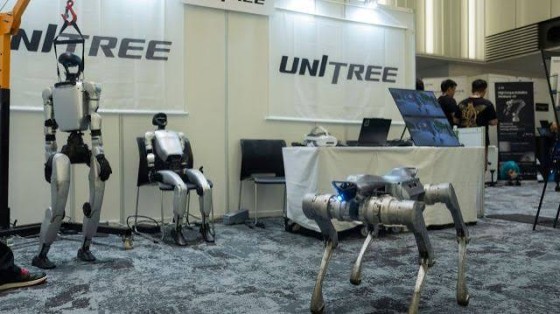
Unitree Unveils High-Speed ‘Superman’ Humanoid Robot Ahead of Shanghai Market Debut
Chinese robotics company Unitree has unveiled a new high-performance humanoid robot demonstrating unusually fast and dynamic movements, reinforcing the company’s ambitions in embodied artificial intelligence as it prepares for a planned stock-market debut in Shanghai.
The latest machine, presented through demonstrations highlighting running speed, agility and advanced full-body movement, has attracted attention as another indication of the rapid progress being made by China’s humanoid-robotics industry.
The unveiling comes at a strategically important moment for Unitree. The Hangzhou-based company has emerged as one of China’s most prominent robotics manufacturers and is preparing for a potential listing as investor interest in humanoid robots, physical AI and intelligent automation continues to grow.
Unitree Pushes Humanoid Robot Performance Further

The latest demonstration focuses heavily on physical capability.
Humanoid robotics presents an unusually difficult engineering challenge because machines need to coordinate multiple joints while continuously maintaining balance.
High-Speed Movement Requires Advanced Control
Walking slowly on a flat surface is already technically demanding for a bipedal robot.
Running introduces much greater complexity.
The control system needs to calculate:
body position,
joint angles,
ground contact,
momentum,
balance,
and trajectory.
These calculations need to happen continuously.
A small error can cause the machine to lose stability.
High-speed demonstrations therefore provide an important test of mechanical design and control software.
‘Superman’ Demonstration Highlights Dynamic Mobility
The description of the robot as a “Superman” humanoid reflects the emphasis on unusually athletic movement rather than a conventional industrial demonstration.
Humanoid Robots Are Becoming More Agile
Earlier generations of humanoid machines often moved slowly and cautiously.
Recent robots can increasingly:
run,
jump,
recover from disturbances,
perform coordinated movements,
and navigate more complicated environments.
These capabilities do not automatically make a robot commercially useful.
However, they demonstrate improvements in motors, actuators, batteries, control algorithms and mechanical engineering.
The next challenge is translating athletic performance into productive work.
Unitree Has Built Reputation Through Dynamic Robots
Unitree initially became widely recognised through its quadruped robots.
Robot Dogs Created Early Commercial Market
Four-legged robots offer several engineering advantages over humanoids.
They have greater inherent stability.
They can navigate difficult terrain.
They can carry sensors and equipment.
Unitree developed relatively affordable quadruped platforms that gained customers across research, education, inspection and development applications.
This experience provided the company with expertise in motors, control systems and robotic locomotion.
Those capabilities now support its humanoid programme.
Humanoid Robots Represent Larger Opportunity
The economic argument for humanoids differs from specialised industrial robots.
Human Environments Are Designed Around Human Bodies
Factories, warehouses, offices and homes contain:
doors,
stairs,
shelves,
tools,
workstations,
and vehicles
designed for human dimensions.
A humanoid robot could theoretically operate within these environments without requiring extensive redesign.
Two arms allow manipulation.
Two legs provide movement through spaces built for people.
Human-like height provides access to conventional equipment.
This compatibility explains why technology companies see potentially enormous commercial opportunity.
Embodied AI Becomes Next Technology Frontier
Humanoid robots combine artificial intelligence with physical machines.
This concept is often described as embodied AI.
AI Must Understand the Physical World
A language model can process digital information.
A humanoid robot must interact with unpredictable physical environments.
It needs to understand:
where objects are,
how heavy they might be,
how they should be grasped,
where humans are located,
and what action should happen next.
The robot must then convert that understanding into physical movement.
This makes embodied intelligence substantially more complicated than software-only AI.
Vision Systems Provide Environmental Awareness
Humanoid robots need continuous perception.
Cameras and Sensors Build Machine Understanding
Robots can use combinations of:
cameras,
depth sensors,
inertial measurement units,
force sensors,
and other sensing technologies.
These systems generate information about the surrounding environment.
AI software then interprets the data.
The robot can identify objects, estimate distance and determine how to move.
Better perception directly improves the range of tasks a machine can perform safely.
Actuators Are Critical to Humanoid Performance
AI receives much of the attention, but mechanical engineering remains equally important.
Every Joint Needs Controlled Movement
A humanoid can contain dozens of powered joints.
Each needs:
motors,
gearing,
sensors,
and control electronics.
Actuators must generate sufficient torque while remaining compact and energy efficient.
They also need to survive repeated motion.
The quality of these components strongly influences speed, strength and reliability.
Unitree’s experience developing proprietary robotic hardware can therefore represent an important competitive advantage.
Batteries Remain Major Constraint
Humanoid robots need substantial electrical power.
Dynamic Movement Consumes Energy Quickly
Running and lifting require considerably more energy than standing.
Larger batteries increase operating time.
But they also increase weight.
Additional weight then requires more energy to move.
Engineers therefore face a difficult optimisation problem.
Battery energy density, motor efficiency and lightweight materials will all influence whether humanoid robots can operate economically for long shifts.
Commercial Use Matters More Than Demonstrations
Spectacular videos can generate enormous public attention.
The real test is whether robots can perform useful work consistently.
Factory Tasks Are Likely Early Market
Manufacturing environments offer several advantages.
They are structured.
Tasks repeat frequently.
Workspaces can be mapped.
Safety zones can be controlled.
This makes factories easier environments for humanoid deployment than unpredictable homes.
Potential tasks include:
moving components,
machine tending,
sorting materials,
inspection,
and repetitive assembly assistance.
Warehouses Provide Another Major Opportunity
Logistics companies already use extensive automation.
Humanoids Could Handle Tasks Between Existing Systems
Modern warehouses contain conveyors, mobile robots and automated storage systems.
Yet humans still perform many tasks because conventional machines cannot easily manipulate varied objects.
Humanoid robots could potentially fill these gaps.
A machine capable of walking through existing warehouses and using human-designed shelves could reduce the need for expensive infrastructure redesign.
This represents one of the strongest arguments for general-purpose humanoids.
China Wants Leadership in Humanoid Robotics
Robotics has become an important part of China's industrial strategy.
Manufacturing Ecosystem Provides Major Advantage
China possesses enormous supply chains for:
motors,
batteries,
electronics,
sensors,
precision components,
and manufacturing equipment.
These industries provide many of the building blocks required for humanoid robots.
Domestic suppliers can potentially reduce component costs and accelerate product iteration.
This manufacturing depth could become one of China's strongest competitive advantages as humanoid production moves toward scale.
Large Domestic Market Supports Deployment
China also has an enormous manufacturing economy.
Factories Can Become Testing Ground
Automotive plants, electronics factories and logistics centres provide potential deployment environments.
Robotics companies can test machines in real commercial conditions.
Every deployment produces additional operational data.
That information can then be used to improve software and hardware.
The relationship between manufacturing scale and AI training could therefore become strategically important.
Unitree Faces Growing Chinese Competition
The company is not alone.
China has developed a rapidly expanding humanoid-robotics ecosystem.
Startups and Technology Groups Enter Market
Numerous companies are developing humanoid machines for industrial, research and consumer applications.
Competition is pushing manufacturers to improve:
performance,
reliability,
cost,
battery life,
and AI capabilities.
The industry could experience rapid consolidation once customers begin distinguishing between impressive prototypes and economically useful products.
Companies able to manufacture reliably at scale are likely to have an advantage.
Tesla Remains Important Global Competitor
Tesla’s Optimus programme has helped increase investor attention toward humanoid robotics.
Tesla Wants Robots Inside Its Own Factories
Tesla has discussed using Optimus machines initially for manufacturing tasks.
The strategy provides an internal customer.
Factories can serve as controlled testing environments before broader commercial deployment.
Tesla also possesses substantial expertise in batteries, electric motors, computer vision and AI.
These capabilities overlap heavily with humanoid robotics.
Unitree and other Chinese companies are therefore competing against organisations with significant technological and financial resources.
Figure AI Focuses on Commercial Deployment
US-based Figure AI has also emerged as a major participant.
Partnerships Can Accelerate Real-World Testing
Figure has pursued industrial partnerships to test humanoid robots in commercial environments.
This deployment-oriented approach reflects an important transition.
The industry is moving from demonstrations toward measurable productivity.
Customers will increasingly ask how many useful tasks a robot can complete per hour rather than how impressive it appears in a video.
That change will determine which companies build sustainable businesses.
Boston Dynamics Remains Robotics Benchmark
Boston Dynamics has spent decades developing highly dynamic robots.
Atlas Demonstrated Extreme Mobility
Its Atlas programme demonstrated running, jumping and sophisticated whole-body movement.
These capabilities established important technical benchmarks.
However, Boston Dynamics historically focused heavily on research and specialised applications.
Newer competitors are placing greater emphasis on reducing manufacturing costs and building robots suitable for mass commercial deployment.
The market is therefore shifting from pure engineering achievement toward economics.
Unitree Competes Aggressively on Price
One of Unitree’s most important characteristics has been its focus on comparatively affordable robotics hardware.
Lower Prices Can Expand Developer Ecosystem
Universities, startups and researchers can experiment more easily when hardware is accessible.
More users create more applications.
That can strengthen the ecosystem surrounding a platform.
The same pattern has occurred in computers, smartphones and drones.
If Unitree can bring humanoid hardware costs down significantly, it could accelerate adoption even before general-purpose robots are ready for mass consumer use.
Shanghai Listing Could Fund Expansion
Unitree’s planned market debut could provide additional capital for growth.
Robotics Requires Heavy Investment
Developing humanoid machines requires spending on:
research,
engineering,
AI training,
manufacturing,
testing,
and supply chains.
Companies also need substantial working capital if they begin producing robots at large scale.
Public-market financing could give Unitree additional resources to expand manufacturing and accelerate product development.
IPO Could Become Test of Robotics Investor Appetite
A Unitree listing would also provide an important signal for capital markets.
Investors Need to Value Emerging Industry
Humanoid robotics does not yet have a mature business model.
Revenue potential is enormous, but uncertainty remains equally substantial.
Investors need to assess:
hardware margins,
production costs,
commercial demand,
software revenue,
competition,
and technological obsolescence.
Unitree’s valuation could therefore become a benchmark for other Chinese robotics companies considering public listings.
Hardware Revenue May Not Be Enough
Long-term robotics economics could extend beyond selling machines.
Software Could Create Recurring Revenue
A company might sell a humanoid robot and then charge for:
AI capabilities,
fleet management,
software upgrades,
maintenance,
and specialised applications.
This would create recurring revenue.
Such a model could improve margins compared with hardware sales alone.
The structure could resemble enterprise technology, where customers purchase equipment but continue paying for software and services.
Robot Data Could Become Strategic Asset
Every deployed humanoid generates information.
Real-World Experience Can Improve AI
A robot performing warehouse work encounters thousands of physical situations.
Objects may be positioned differently.
People may interrupt tasks.
Lighting conditions change.
Equipment can move.
Collecting this experience can help train better control models.
Companies operating larger robot fleets could therefore gain a data advantage.
This creates a potential feedback loop.
More robots produce more data.
More data improves AI.
Better AI makes robots more useful.
More useful robots attract more customers.
Safety Will Determine Commercial Acceptance
Humanoid robots are physically powerful machines designed to operate near people.
Control Failures Can Have Real Consequences
A software error in a chatbot produces incorrect information.
A control error in a humanoid robot can cause physical damage.
Commercial systems therefore need:
collision detection,
force limits,
emergency shutdown,
redundant controls,
and reliable human recognition.
Regulatory standards will likely become more important as deployment increases.
Companies that establish strong safety records could gain a major commercial advantage.
Reliability Is Equally Important
Factories cannot depend on machines that frequently stop working.
Robots Need Thousands of Operating Hours
A commercially useful humanoid needs to repeat tasks continuously.
Motors cannot fail frequently.
Joints cannot require constant repair.
Sensors need to remain calibrated.
Software needs to recover from unexpected situations.
Reliability engineering will therefore become just as important as AI capability.
A slower robot operating reliably for an entire shift can be more valuable than a spectacularly fast robot requiring frequent maintenance.
Humanoid Economics Will Be Measured Against Human Labour
Businesses ultimately make investment decisions based on productivity.
Total Cost of Ownership Matters
The purchase price is only one factor.
Customers need to calculate:
maintenance,
electricity,
software subscriptions,
downtime,
supervision,
and useful operating life.
These costs can then be compared with the value of tasks performed.
Humanoid robots do not necessarily need to cost less than human workers in every situation.
They can also create value by performing dangerous, repetitive or physically demanding tasks.
High-Speed Capability Can Have Practical Benefits
The latest Unitree demonstration is not merely about spectacle.
Faster Movement Can Increase Productivity
A warehouse robot that walks twice as quickly can potentially complete more transport tasks.
A factory robot capable of moving efficiently between stations can reduce idle time.
Speed therefore has commercial value.
But only when combined with safety and accuracy.
An extremely fast robot that requires large exclusion zones around workers may be less useful than a slower machine capable of operating safely alongside them.
General-Purpose Robotics Remains Ultimate Goal
The largest economic opportunity would come from machines capable of learning many different tasks.
Specialised Robots Already Dominate Automation
Factories currently use robotic arms designed for specific jobs.
Warehouses use autonomous mobile robots.
Restaurants use specialised delivery machines.
These systems work well because their task scope is limited.
Humanoids promise something different.
One machine could potentially perform multiple activities using the same body.
That flexibility could radically change automation economics.
AI Models Could Teach Robots New Skills Faster
Traditional industrial robots often require explicit programming.
Modern AI could reduce this requirement.
Robots Can Learn From Demonstrations
A human can potentially show a robot how to perform a task.
The system can observe movements and infer the required sequence.
Simulation can generate additional training examples.
Robots could also eventually learn from data collected by other machines.
This could dramatically reduce the cost of programming each new task.
Mass Production Could Lower Humanoid Costs
Today's advanced humanoids remain expensive.
The economics could change rapidly with scale.
Automotive Manufacturing Provides Useful Analogy
Electric vehicles became more affordable as battery production and manufacturing volumes increased.
Humanoid robots use many related technologies.
Motors.
Batteries.
Power electronics.
Sensors.
AI processors.
If manufacturers produce hundreds of thousands of robots, component costs could decline substantially.
China's manufacturing ecosystem may be particularly well positioned to exploit these economies of scale.
Supply Chain Control Could Become Unitree Advantage
Unitree has focused on developing important robotic components internally.
Vertical Integration Can Reduce Costs
A company buying every actuator and controller from external suppliers pays supplier margins.
Designing key components internally can reduce costs and allow tighter optimisation.
It can also accelerate product development.
However, vertical integration requires substantial engineering resources.
Unitree’s ability to balance internal development with external sourcing will influence its manufacturing economics.
Humanoid Robots Could Become Major AI Hardware Market
The AI boom has so far been dominated by data centres.
Humanoid robotics could create another enormous source of semiconductor demand.
Every Robot Needs Computing Power
A sophisticated humanoid requires processors for:
computer vision,
motion control,
AI inference,
communications,
and sensor processing.
Large-scale robot deployment could therefore create significant demand for AI chips.
Semiconductor companies increasingly view physical AI as a future growth market beyond cloud computing.
Nvidia Is Building Robotics Ecosystem
Nvidia has positioned robotics as an important extension of its AI platform.
Simulation Can Accelerate Robot Training
Training physical robots entirely in the real world is slow and expensive.
Simulation allows developers to generate enormous quantities of synthetic experience.
Robots can practise tasks virtually before executing them physically.
Advanced AI computing platforms can then transfer learned behaviours to real machines.
This could accelerate development across the entire humanoid industry.
China’s Robotics Push Has Global Implications
If Chinese manufacturers achieve significant cost advantages, the effects could extend worldwide.
Affordable Robots Could Accelerate Automation
Lower hardware prices make automation economically viable for more businesses.
Small manufacturers that cannot afford sophisticated industrial systems today could eventually deploy humanoids.
Logistics companies could automate more repetitive work.
Service industries could experiment with new applications.
The resulting productivity gains could be substantial.
At the same time, labour markets would need to adapt.
India Could Become Important Future Market
India’s manufacturing and logistics sectors could eventually become significant users of humanoid robots.
Adoption Will Depend on Economics
India has lower labour costs than many developed economies.
That makes expensive humanoid robots more difficult to justify purely as labour substitutes.
However, the economics could become attractive for:
hazardous work,
precision manufacturing,
24-hour operations,
warehousing,
and tasks facing skilled-labour shortages.
As robot prices decline, the addressable Indian market could expand.
India Could Also Participate in Robotics Supply Chain
The opportunity is not limited to buying robots.
Electronics Manufacturing Creates Industrial Base
India is expanding electronics, semiconductor packaging, automotive components and advanced manufacturing.
These capabilities overlap with parts of the robotics supply chain.
Motors, batteries, sensors, electronics and software all represent potential areas for domestic participation.
China's rapid progress demonstrates how valuable an integrated robotics ecosystem can become.
Unitree’s Market Debut Could Mark Industry Milestone
The company's planned Shanghai listing arrives as humanoid robotics transitions from research curiosity toward commercial industry.
Public Markets Will Demand Financial Results
Private investors can fund long development cycles based on future potential.
Public shareholders eventually expect revenue growth and improving profitability.
That could push Unitree toward faster commercial deployment.
The company will need to demonstrate that impressive robot demonstrations can translate into repeatable customer demand.
Conclusion
Unitree’s latest high-speed “Superman” humanoid demonstration reinforces China’s increasingly important position in the global race to commercialise embodied artificial intelligence.
The machine highlights advances in locomotion, control systems, actuators and whole-body coordination, but the larger story extends beyond athletic performance.
Unitree is approaching a crucial transition from robotics innovator toward scaled commercial manufacturer as it prepares for a potential Shanghai market debut.
The company now needs to demonstrate that humanoids can move beyond impressive demonstrations and deliver reliable productivity in factories, warehouses and other real-world environments.
Competition from Tesla, Figure AI, Boston Dynamics and a rapidly expanding group of Chinese robotics companies ensures that technological progress will remain intense.
The eventual winner may not be the company whose robot runs fastest. It is more likely to be the company that combines capable AI, reliable hardware, low manufacturing costs and scalable production into a machine businesses can economically deploy every day.