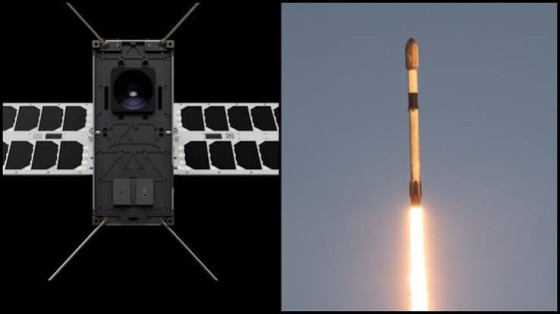
MOI-1A Scheduled to Launch on Falcon 9 Today
MOI-1A is scheduled for launch from California aboard SpaceX's Falcon 9 on October 1 as part of the Transporter-18 mission.
The spacecraft is a compact 6U CubeSat weighing about 14 kg and is designed primarily as an orbital computing platform rather than a conventional Earth-observation satellite.
Following launch, the spacecraft is expected to proceed through deployment, orbital injection and commissioning before beginning customer computing workloads.
The mission represents the next stage of TakeMe2Space's efforts to demonstrate that meaningful AI workloads can be executed directly in low-Earth orbit.
Nvidia Orin NX Processors Power the Satellite

At the heart of MOI-1A are Nvidia Orin NX processors capable of delivering up to 117 trillion operations per second of computing performance.
The spacecraft also carries 16 GB of RAM and approximately 2 TB of onboard storage.
This computing capability enables MOI-1A to perform AI inference while orbiting Earth rather than depending entirely on terrestrial computing infrastructure.
Customers can upload containerised AI models to the spacecraft and specify geographic regions where they want those models to operate.
As MOI-1A passes over the selected area, it can process relevant imagery and data onboard and transmit the resulting intelligence instead of the complete underlying dataset.
Why Processing Data in Orbit Matters
Traditional Earth-observation satellites can collect enormous volumes of information, but transmitting that data to Earth creates a bottleneck.
Satellite downlink capacity is limited, and transferring large raw datasets requires time and ground-station resources.
Orbital computing changes this model by processing information close to where it is generated.
For example, instead of downloading every image captured over an agricultural region, an AI model aboard the satellite could identify crop stress and transmit only the relevant analysis.
Similar approaches could be used to identify mining activity, infrastructure changes, ships, floods or other features without requiring every raw image to reach Earth first.
MOI-1A Carries Multispectral Imaging Capability
MOI-1A combines onboard computing with a nine-band multispectral optical imager.
Multispectral imaging captures information across several wavelength bands, enabling applications that extend beyond conventional photography.
Such data can be useful for analysing vegetation, agriculture, land conditions and other environmental characteristics.
Combining the imager with onboard AI means information can potentially be analysed immediately after collection, reducing the amount of data that needs to be transmitted to terrestrial infrastructure.
This integration of sensing and computing is central to TakeMe2Space's orbital-computing strategy.
TakeMe2Space Has Signed 23 Customers
TakeMe2Space has already signed 23 customers for the MOI-1A mission.
They include geographic-information-system companies, educational institutions and commercial users operating in agriculture, mining, supply-chain management and insurance.
US-based space-data analytics company Little Place Labs is among the customers.
These users will be able to run selected computing workloads aboard the satellite, providing TakeMe2Space with an opportunity to test orbital computing as a commercial service rather than solely as a technology demonstration.
OrbitLab Opens Satellite Computing to Customers
TakeMe2Space is developing its orbital computing business around a software platform called OrbitLab.
The platform is intended to allow users to upload AI models and applications to computing infrastructure in orbit without having to develop and operate their own satellites.
This approach resembles aspects of terrestrial cloud computing, where customers purchase computing capacity instead of owning the underlying hardware.
TakeMe2Space says processing data onboard can substantially reduce transmission requirements because customers receive the useful intelligence generated from the data rather than every raw file collected by the spacecraft.
Mission Follows Earlier Orbital AI Demonstration
MOI-1A builds on TakeMe2Space's earlier MOI-TD technology-demonstration mission, launched in December 2024.
That spacecraft successfully demonstrated capabilities including uploading applications from Earth, executing AI inference in orbit and transmitting results back to ground infrastructure.
TakeMe2Space said the mission conducted more than 20 experiments in low-Earth orbit.
The demonstration provided technical validation for the company's broader idea of offering computing infrastructure aboard satellites.
MOI-1A Replaces Satellite Lost in Earlier Launch Failure
TakeMe2Space had planned to advance its commercial orbital-computing programme with MOI-1.
However, that satellite was lost following a launch-vehicle failure in January 2026.
The company subsequently developed MOI-1A as a replacement and secured a launch opportunity aboard SpaceX's Transporter-18 mission.
The relatively rapid return to launch illustrates the company's effort to keep its orbital-computing roadmap moving despite the earlier setback.
Company Plans Larger Networked Satellites
MOI-1A represents an early generation of TakeMe2Space's planned orbital infrastructure.
The company intends to develop larger and more powerful satellites capable of supporting substantially greater computing workloads.
Its longer-term strategy involves multiple spacecraft operating as a network rather than independent orbital computers.
TakeMe2Space has also outlined plans for two approximately 100-kg satellites targeted for a Falcon 9 mission in 2028. Those spacecraft are expected to include more powerful computing hardware, larger storage capacity and optical inter-satellite links.
The links would allow workloads and information to move between satellites, an important capability for creating distributed computing infrastructure in orbit.
Orbital Data Storage Is Another Target Market
Beyond Earth-observation analytics, TakeMe2Space is exploring orbital data storage.
The company wants to offer space-based cold storage for critical information, potentially giving organisations an additional backup location beyond conventional terrestrial cloud infrastructure.
Financial-services and defence organisations are among the potential customers identified for such services.
However, these applications remain part of the company's longer-term roadmap and will require larger-scale infrastructure than the current MOI-1A mission.
India Builds a Growing Private Space Ecosystem
TakeMe2Space is part of India's expanding private spacetech ecosystem, which now includes companies developing rockets, satellites, propulsion systems, Earth-observation services and space-based data platforms.
Policy reforms and the development of institutions such as IN-SPACe have opened more opportunities for private companies to participate in the country's space economy.
MOI-1A adds orbital computing to the technologies being pursued by Indian startups.
Its commercial significance will ultimately depend not simply on reaching orbit, but on whether TakeMe2Space can reliably run customer AI workloads and deliver useful results at competitive costs.
Conclusion
TakeMe2Space's scheduled MOI-1A launch aboard SpaceX's Falcon 9 on October 1, 2026, represents an important test of India's emerging orbital-computing capabilities.
The 14-kg spacecraft combines Nvidia Orin NX processors, onboard storage and multispectral imaging to process Earth-observation data using AI directly in orbit.
With 23 customers already signed for the mission, MOI-1A is designed to move TakeMe2Space beyond technology demonstrations toward commercial orbital computing. Successful deployment and commissioning will be the next critical milestones after today's scheduled launch.