Neural Networks Explained: How They Work, Types, Applications and Benefits
Neural Networks are one of the foundational technologies behind modern Artificial Intelligence (AI). Inspired by the structure and functioning of the human brain, neural networks enable computers to recognize patterns, process complex information, and make intelligent decisions from large datasets. They power many of today's most advanced AI applications, including image recognition, speech assistants, language translation, recommendation systems, fraud detection, autonomous vehicles, and generative AI models. As businesses continue to embrace AI-driven digital transformation, neural networks have become essential for solving complex real-world problems across industries.
What Are Neural Networks?
A neural network is a computational model composed of interconnected nodes, often called artificial neurons, that work together to process information. These networks learn by analyzing large volumes of data and adjusting internal parameters to improve prediction accuracy over time.
How Neural Networks Work
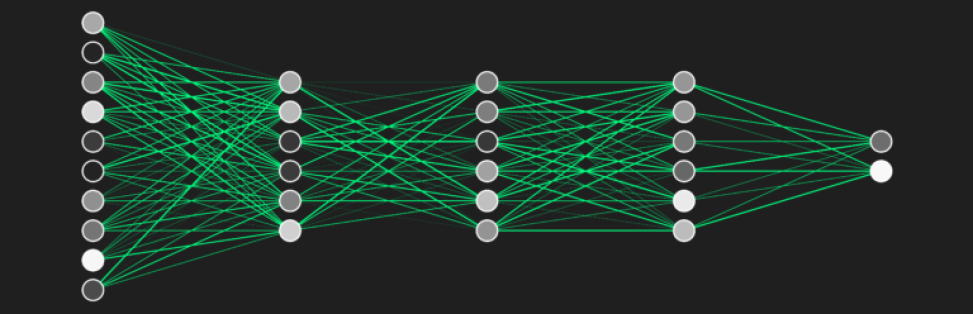
A neural network receives data through an input layer, processes information across one or more hidden layers, and produces results through an output layer. During training, the network continuously adjusts the strength of connections between neurons to minimize errors and improve performance.
Why Neural Networks Matter
Unlike traditional software that follows fixed programming rules, neural networks learn from experience. This capability allows them to solve problems involving image recognition, speech processing, natural language understanding, forecasting, and complex decision-making with remarkable accuracy.
Types of Neural Networks
Different neural network architectures are designed to solve specific types of problems depending on the nature of the data.
Feedforward Neural Networks
Feedforward Neural Networks are the simplest form of neural network. Information moves in one direction—from input to output—making them suitable for classification, prediction, and regression tasks.
Convolutional Neural Networks (CNNs)
CNNs are designed to process images and visual information. They automatically identify features such as shapes, textures, and objects, making them widely used in facial recognition, medical imaging, and autonomous driving.
Recurrent Neural Networks (RNNs)
Recurrent Neural Networks are specialized for sequential data such as text, speech, and time-series information. They are commonly used in language translation, speech recognition, and predictive analytics.
Transformer Networks
Transformer architectures have become the foundation of modern generative AI and large language models. They process massive amounts of text efficiently and support applications such as chatbots, content generation, search, and language understanding.
Key Components of Neural Networks
Several elements work together to enable neural networks to learn effectively.
Artificial Neurons
Artificial neurons receive inputs, perform mathematical calculations, and pass outputs to other neurons within the network. Millions of these interconnected neurons can work together to solve highly complex problems.
Activation Functions
Activation functions determine whether a neuron should pass information to the next layer. They help neural networks capture complex, non-linear relationships within data.
Training and Backpropagation
Neural networks improve by comparing predictions with actual results and adjusting internal parameters through a process known as backpropagation. This iterative learning process continues until the model reaches acceptable accuracy.
Applications of Neural Networks
Neural networks have become indispensable across multiple industries due to their ability to process massive datasets and identify complex patterns.
Healthcare
Healthcare organizations use neural networks for disease diagnosis, medical image analysis, drug discovery, patient monitoring, and personalized treatment recommendations.
Banking and Financial Services
Financial institutions apply neural networks to fraud detection, credit scoring, algorithmic trading, customer analytics, and risk management.
Retail and E-commerce
Retail businesses leverage neural networks for recommendation engines, demand forecasting, inventory optimization, personalized marketing, and customer behavior analysis.
Manufacturing
Manufacturers use neural networks for predictive maintenance, automated quality inspection, robotics, and production optimization to improve operational efficiency.
Benefits of Neural Networks
Neural networks provide significant advantages for organizations adopting Artificial Intelligence technologies.
High Prediction Accuracy
Neural networks can identify complex patterns that traditional algorithms may overlook, leading to highly accurate predictions and classifications.
Automation of Complex Tasks
They enable automation of sophisticated processes such as image recognition, voice processing, language translation, and intelligent decision-making.
Continuous Learning
As more data becomes available, neural networks can be retrained and improved, allowing organizations to enhance performance over time.
Challenges of Neural Networks
Despite their capabilities, neural networks also present technical and operational challenges.
Large Data Requirements
Training high-performing neural networks often requires massive datasets, which can be expensive and time-consuming to collect and prepare.
High Computing Power
Complex neural networks demand significant processing power, memory, and specialized hardware such as GPUs for efficient training and deployment.
Explainability and Ethics
Many neural networks function as "black box" models, making it difficult to explain how decisions are made. Organizations must also address fairness, transparency, privacy, and regulatory compliance.
Future of Neural Networks
Neural networks are expected to remain at the center of Artificial Intelligence innovation. Advances in computing infrastructure, model architectures, and training techniques will enable increasingly powerful AI systems capable of solving more complex business and scientific challenges. As adoption expands across industries, neural networks will continue driving automation, innovation, and intelligent decision-making on a global scale.
Conclusion
Neural networks have transformed the field of Artificial Intelligence by enabling machines to learn from experience and solve problems that were once considered beyond the capabilities of computers. From healthcare and finance to manufacturing and retail, they continue to power many of today's most advanced AI applications. As technology continues to evolve, neural networks are expected to play an even greater role in shaping the future of intelligent systems and digital transformation.