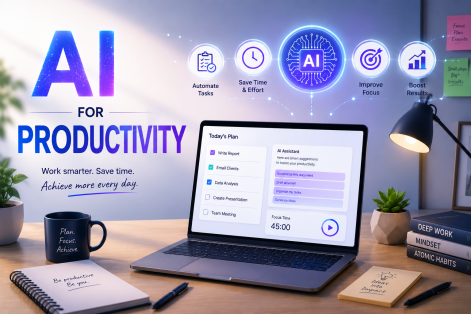
AI for Productivity: How Artificial Intelligence Boosts Workplace Efficiency
Artificial Intelligence (AI) is transforming workplace productivity by helping individuals and organizations automate repetitive tasks, manage information, improve collaboration, and make faster decisions. From drafting documents and summarizing meetings to organizing schedules and analyzing business data, AI-powered tools enable employees to focus on high-value work instead of routine administrative tasks. As businesses continue embracing digital transformation, AI has become a key driver of efficiency, innovation, and operational excellence across industries.
What Is AI for Productivity?

AI for productivity refers to the use of Artificial Intelligence technologies to improve workplace efficiency, automate routine tasks, support decision-making, and optimize daily workflows for individuals and organizations.
How AI for Productivity Works
AI combines machine learning, Natural Language Processing (NLP), Generative AI, and intelligent automation to understand user requests, process information, generate content, organize data, and streamline business operations.
Why AI for Productivity Matters
AI helps employees save time, reduce manual effort, improve work quality, and complete tasks more efficiently while allowing organizations to increase overall productivity.
Key Applications of AI for Productivity
AI is enhancing productivity across nearly every business function.
Content Creation and Document Management
AI assists with writing emails, reports, presentations, meeting summaries, proposals, and business documents while maintaining consistency and reducing drafting time.
Workflow Automation
Businesses use AI to automate repetitive tasks such as scheduling meetings, managing calendars, processing documents, updating records, and handling routine administrative work.
Data Analysis and Decision Support
AI quickly analyzes large datasets, identifies trends, generates reports, and provides actionable insights that help professionals make informed business decisions.
Benefits of AI for Productivity
AI offers significant advantages for professionals and organizations.
Time Savings
By automating repetitive processes, AI allows employees to spend more time on strategic thinking, creativity, and customer-focused activities.
Improved Accuracy
AI reduces manual errors in documentation, data processing, reporting, and routine business operations.
Better Collaboration
AI-powered assistants improve communication by summarizing meetings, organizing shared knowledge, tracking tasks, and supporting team collaboration across departments.
Challenges of AI for Productivity
Despite its benefits, AI implementation presents several challenges.
Learning Curve
Employees may require training to effectively integrate AI tools into their daily workflows and maximize productivity gains.
Data Security
Organizations must ensure AI systems protect sensitive business information and comply with cybersecurity and privacy requirements.
Human Oversight
AI enhances workplace efficiency, but human judgment remains essential for strategic planning, creative thinking, and complex decision-making.
Future of AI for Productivity
AI is expected to become an even more integral part of workplace productivity through intelligent assistants, autonomous AI agents, multimodal AI, and advanced workflow automation. Future AI platforms will proactively organize work, prioritize tasks, generate insights, and coordinate business processes with minimal manual intervention. As Artificial Intelligence continues to evolve, AI-powered productivity tools will become indispensable for businesses seeking greater efficiency, collaboration, and innovation.
Conclusion
Artificial Intelligence is redefining productivity by automating routine work, improving collaboration, and enabling faster, more informed decision-making. From content creation and workflow automation to intelligent analytics and task management, AI empowers individuals and organizations to work more efficiently and effectively. As AI technologies continue to mature, AI for Productivity will play a central role in helping businesses enhance performance, reduce operational complexity, and achieve sustainable growth.