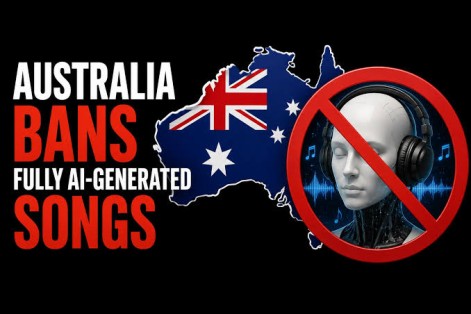
Australia Bans Fully AI-Generated Music From Official National Charts
Australia's main music charts are introducing one of the clearest boundaries yet between human-created music and recordings generated primarily by artificial intelligence.
The Australian Recording Industry Association, which operates the ARIA Charts, has confirmed that wholly AI-generated tracks will no longer be eligible for its charts. Recordings that use generative AI only in a supporting role can remain eligible when the work is substantially human-made. (ARIA)
The updated rules take effect for the ARIA chart dated August 31, 2026, which is published on August 28. (ARIA)
The policy does not amount to a blanket prohibition on musicians using artificial intelligence.
Instead, ARIA is drawing a distinction between:
AI-generated music
and
AI-assisted music.
That distinction could become increasingly important as generative-AI platforms make it possible for users to produce vocals, instrumentation and complete recordings from relatively simple prompts.
Wholly AI-Generated Tracks Will Be Ineligible

Under ARIA's updated Charts Code of Practice, recordings developed using generative AI can qualify only when they satisfy two central conditions.
They must be:
substantially human made
and must raise:
no stream or chart manipulation concerns. (ARIA)
A recording produced primarily or entirely by generative AI therefore cannot compete alongside qualifying human-created recordings on the ARIA Charts.
AI-Assisted Music Can Still Chart
The new rules do not prohibit artists from incorporating generative AI into the creative process.
ARIA explicitly says recordings using generative AI in a supporting role remain eligible. (ARIA)
This distinction acknowledges that AI tools are already entering professional music production.
Musicians may increasingly use AI for selected creative or technical processes without surrendering primary creative control over a recording.
What Counts as AI-Generated Music?
ARIA has adopted definitions based on a global music-industry labelling standard announced in July.
A track is classified as AI-Generated when generative AI produces the entirety or primary portion of its creative elements.
ARIA provides examples including:
AI-generated lead vocals,
AI-generated key instrumental performances,
or entirely prompt-generated music. (ARIA)
The central question is therefore not simply whether AI was used.
It is how much of the core creative performance came from humans.
What Counts as AI-Assisted Music?
An AI-Assisted recording is substantially created by humans and expresses human creativity while generative AI contributes some expressive elements.
Under ARIA's definition, humans perform the lead vocal and primary instruments in an AI-assisted recording. (ARIA)
That leaves room for musicians to experiment with emerging technology while remaining eligible for chart recognition.
The Rules Follow a High-Profile AI Music Controversy
The decision follows scrutiny surrounding Australian DJ and producer Josh Fawaz's cover of Madonna's "Like a Prayer."
The recording became the most-played track on Australian radio and reached No. 4 on two ARIA charts in July, according to ABC News. Questions subsequently emerged about the role generative AI played in the production. (ABC News)
Fawaz said he had used AI as a tool and later updated information associated with the Spotify release to indicate that the vocals and drums were AI-generated. (ABC News)
The controversy highlighted a problem the music industry is likely to encounter more frequently.
Listeners can consume a recording millions of times without necessarily knowing whether the performer they hear is human.
Generative AI Has Dramatically Lowered Music-Production Barriers
Traditional music production can require:
songwriters,
singers,
instrumentalists,
producers,
and recording engineers.
Generative-AI platforms can potentially perform several of those functions through software.
A user may describe:
a genre,
a mood,
a vocal style,
and instrumentation,
and receive a generated recording.
That fundamentally changes the economics of producing music.
Anyone Can Potentially Become a Music Producer
The technological barrier to creating a polished-sounding recording is declining.
People without traditional musical training can increasingly experiment with generating songs.
This can dramatically increase the quantity of music available on streaming platforms.
But it also creates difficult questions around what should qualify for professional industry recognition.
Charts Were Designed to Measure Music Consumption
Music charts historically measure which recordings audiences are buying or listening to.
ARIA says its charts are intended to reflect and inform consumer choice and now incorporate physical sales, digital sales and streaming activity. (ARIA)
Generative AI complicates that model.
If consumers stream an AI-generated song millions of times, the consumption itself is real.
But the recording may not represent human artistic performance in the traditional sense.
ARIA has decided that consumption alone is no longer sufficient for eligibility.
Human Authorship Is Becoming an Eligibility Requirement
The new policy effectively introduces a creative threshold.
A recording must involve substantial human creativity to receive official chart recognition.
That represents an important philosophical change.
Charts are no longer merely asking:
How many people listened?
They may also need to ask:
Who—or what—created the music?
ARIA Can Remove Ineligible Tracks
ARIA has given itself significant enforcement powers under the updated rules.
If it determines that a recording is ineligible, it may:
decline to accept the recording,
exclude or remove it from charts,
adjust chart positions,
withdraw accreditations,
and revoke or request the return of an ARIA No. 1 Award. (ARIA)
These actions can be applied prospectively or retrospectively.
AI-Generated Tracks Can Also Lose Award Eligibility
The consequences extend beyond weekly chart rankings.
ARIA says a recording determined to be ineligible under the updated chart rules will also be ineligible for an ARIA Award. (ARIA)
This creates a consistent principle across both commercial chart recognition and industry awards.
Artists Can Challenge an Exclusion
ARIA has also updated its disputes process.
Artists and their representatives can contest an exclusion and provide evidence demonstrating that a recording meets eligibility requirements. (ARIA)
That safeguard could become increasingly important because distinguishing AI-generated from AI-assisted recordings may not always be straightforward.
Proving Human Creation Could Become Important
Artists may eventually need to maintain clearer documentation of their creative process.
Evidence could potentially include:
recording sessions,
production files,
vocal recordings,
instrument tracks,
and information about AI tools used during production.
Music metadata may also become more important.
AI Labelling Is Emerging as a Global Standard
ARIA's decision follows a wider music-industry effort to establish common terminology for AI involvement in recordings.
In July, the global music community announced two track-level labels:
AI-Generated
and
AI-Assisted.
The initiative involved organisations including IFPI, RIAA, A2IM, WIN, IMPALA, the Recording Academy, SAG-AFTRA and the Human Artistry Campaign. (ARIA)
ARIA subsequently adopted those definitions for chart eligibility.
Transparency Is Becoming Critical
Consumers may eventually expect AI information alongside other music metadata.
Listeners already see information such as:
artist,
album,
release date,
and songwriter credits.
AI disclosure could become another standard field.
This would allow audiences to understand how much generative technology contributed to a recording.
AI Music Raises Copyright Questions
Chart eligibility is only one part of the debate.
Generative music also creates major questions around copyright.
AI models may be trained using large collections of existing recordings.
Artists and record companies want clarity over whether copyrighted music can be used to train commercial AI systems without permission or compensation.
ARIA has explicitly linked AI policy with the importance of creators retaining consent over how their work is used. (ARIA)
Training Data Is Central to the Dispute
Generative AI does not create music in isolation.
Models learn patterns from large datasets.
The music industry therefore wants answers to several questions:
Which recordings were used?
Were rights holders asked?
Should artists be compensated?
Can generated output imitate identifiable performers?
These issues are likely to shape future licensing models.
Voice Replication Creates Another Challenge
AI systems can increasingly generate convincing synthetic vocals.
This creates the possibility of recordings that sound like recognised singers without those artists performing them.
That raises questions involving:
identity,
copyright,
publicity rights,
and consumer deception.
The issue becomes particularly sensitive when generated music is commercially distributed.
Record Labels Are Exploring Licensing Models
The long-term relationship between AI companies and music companies may ultimately depend heavily on licensing.
Instead of prohibiting AI entirely, rights holders could license catalogues for approved model training under negotiated commercial terms.
That could potentially create another revenue stream for artists and labels.
But licensing requires transparent information about how models are trained and how generated outputs are used.
AI Could Still Become a Major Artist Tool
The debate should not be interpreted as the music industry rejecting artificial intelligence altogether.
AI can potentially assist musicians with:
production,
sound design,
editing,
and experimentation.
Artists have historically adopted new technologies whenever those tools expanded creative possibilities.
Synthesizers were once disruptive.
Digital audio workstations transformed recording.
Auto-Tune changed vocal production.
AI could become another major production technology.
The Difference Is Creative Control
The central issue is who remains responsible for the artistic work.
ARIA's framework allows technology to assist human creators.
It draws the line when AI becomes responsible for the primary creative elements.
That distinction may become an influential model for other cultural industries.
Film Could Face Similar Questions
AI-generated video is improving rapidly.
Film awards may eventually need to determine how much AI-generated performance or imagery is acceptable.
Questions could arise around:
synthetic actors,
AI-generated cinematography,
and machine-generated scripts.
The music industry's current debate may therefore foreshadow much broader cultural-policy questions.
Publishing Faces Similar Challenges
Books and journalism are also confronting generative AI.
Publishers need to distinguish between:
human-written work using AI assistance
and
content generated primarily by machines.
The same underlying principle appears repeatedly:
When does a tool stop assisting a creator and become the creator?
Advertising Is Already Addressing AI Authorship
ARIA's own 2026 advertising award criteria state that recordings and advertisements containing no human authorship are ineligible.
AI elements can be used only where a human remains the primary creator and the human contribution is substantial and meaningful. (ARIA)
This demonstrates how the human-authorship principle is extending beyond conventional recorded music.
Streaming Platforms Will Play an Important Role
Music charts depend heavily on streaming data.
Streaming platforms therefore sit at the centre of the AI music debate.
They may increasingly need systems capable of:
identifying AI-generated recordings,
displaying AI labels,
and detecting artificial streaming.
The volume of uploaded music makes this technically difficult.
AI Can Produce Music at Enormous Scale
A human artist has limited creative capacity.
Writing, recording and producing an album takes time.
An AI system can potentially generate thousands of recordings rapidly.
That creates a fundamental asymmetry.
If AI-generated tracks flood streaming platforms, human musicians could find themselves competing against effectively unlimited content.
Chart Manipulation Is Another Concern
ARIA's rules specifically require eligible AI-assisted recordings to raise no concerns about stream or chart manipulation. (ARIA)
This matters because generative AI can potentially automate both sides of the music ecosystem.
AI can generate songs.
Automated systems can also potentially generate artificial listening activity.
That combination could undermine chart integrity if not controlled.
Charts Need Trusted Data
Music rankings matter commercially.
Chart success can influence:
media coverage,
playlists,
touring opportunities,
and artist reputation.
If rankings can be manipulated by automated production and artificial streams, their credibility declines.
ARIA's updated policy therefore addresses not only creativity but also market integrity.
Radio Is Being Asked to Respond
ARIA CEO Annabelle Herd has called on organisations that decide which music Australian audiences hear—particularly radio—to support human artistry and adopt similar approaches. (ARIA)
Radio operates separately from ARIA's charts.
That means chart exclusion alone does not necessarily prevent an AI-generated recording from receiving airplay.
A broader industry response would therefore require cooperation across platforms.
Consumers Will Ultimately Influence the Outcome
Regulation and industry standards can determine eligibility.
But audiences determine demand.
Some listeners may prefer music created entirely by humans.
Others may not care how a recording was produced if they enjoy it.
A third group may actively seek AI-generated music.
The industry may therefore develop separate markets rather than one completely replacing the other.
Human-Made Could Become a Valuable Label
Ironically, the growth of artificial intelligence could increase the commercial value of verified human creation.
Products in other industries already emphasise characteristics such as:
handmade,
organic,
or artisanal.
Music could develop a comparable distinction.
A verified human-created label might eventually become part of how artists market authenticity.
AI Music May Develop Its Own Category
Exclusion from traditional charts does not mean AI-generated music will disappear.
Dedicated:
AI charts,
platforms,
genres,
or awards
could eventually emerge.
That would allow audiences interested in machine-generated music to discover it without requiring traditional music institutions to redefine human artistic recognition.
Australia Could Influence Other Markets
ARIA's policy is particularly important because national chart organisations often observe how peers respond to emerging technology.
If the Australian framework works effectively, similar eligibility standards could spread internationally.
The underlying global definitions already provide a foundation for greater consistency across markets. (ARIA)
The Rule Will Need to Evolve
Artificial intelligence is developing rapidly.
Today's distinction between human and machine creation may become harder to apply as creative workflows become more integrated.
ARIA has acknowledged this reality and says its Code will remain under review as AI policy and technology evolve. (ARIA)
That flexibility will be essential.
Conclusion
Australia's decision to exclude wholly AI-generated recordings from the ARIA Charts establishes one of the clearest boundaries yet between artificial intelligence as a creative tool and artificial intelligence as the primary creator of music.
Under the updated rules, recordings must be substantially human made and free from stream or chart-manipulation concerns to remain eligible. AI-assisted music can continue competing when human creativity remains central. (ARIA)
The policy arrives after growing controversy around AI-generated and AI-assisted recordings entering mainstream music distribution and gaining substantial radio and chart exposure.
But the implications extend far beyond a single song.
Generative AI is forcing the music business to answer fundamental questions about authorship, copyright, transparency, compensation and what official cultural recognition is intended to reward.
ARIA's answer is increasingly clear:
AI can participate in the creative process, but human artistry must remain at its centre.
As generative technology becomes more capable, that distinction may become one of the defining rules shaping the next era of the global music industry.