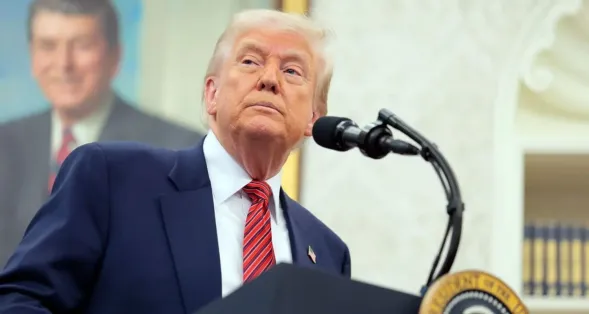
With India and Pakistan on the brink of full-scale conflict following India’s Operation Sindoor, the world is watching with bated breath—and so is former U.S. President Donald Trump, who broke his silence in a press conference, calling the rising hostilities “a shame” and expressing hope that it ends “very quickly.”
Trump’s remarks come in the aftermath of India’s airstrike on nine terror camps within Pakistan’s territory, a bold maneuver that has significantly elevated tensions across the subcontinent. While India framed the operation as a necessary counter-terrorism measure, Pakistan labeled it an act of war, vowing military retaliation.
Speaking to reporters at a business summit in Florida, Trump said:
“It’s a shame what’s happening between India and Pakistan. Both are incredible countries. I hope it ends very quickly, because things could get very nasty, very fast.”
Trump’s tone was measured, but his words echoed the deep unease within the international diplomatic community, as fears grow over the possibility of nuclear confrontation between the two longtime rivals.
Operation Sindoor, launched just days ago, has been hailed within India as a strategic victory aimed at crippling cross-border terrorism. However, the move has also shattered diplomatic silence, leading to emergency meetings at the United Nations Security Council and back-channel negotiations through third-party countries including Russia, China, and the United Arab Emirates.
As Indian and Pakistani forces mobilize on both sides of the Line of Control, airports near border regions are on red alert, citizens are being advised to remain indoors, and military reserves have been quietly activated.
Trump, who once offered to mediate between India and Pakistan during his presidency, also noted:
“When I was in office, we tried to cool things down. Hopefully, leaders on both sides will realize the cost of war is too high.”
His comments have drawn mixed reactions. Indian officials have largely ignored them, while some Pakistani commentators welcomed his concern as a possible path to de-escalation.
Meanwhile, world leaders including UK Prime Minister, UN Secretary-General, and the EU Commission President have issued urgent calls for restraint and dialogue. The United Nations has invited both countries to the table for immediate diplomatic talks, but neither side has responded officially.
As of now, the South Asian region remains on a knife’s edge. One wrong move—intentional or accidental—could tip the balance into open warfare.
The world watches, holds its breath, and hopes that Trump’s words—though casual—won’t become a prophecy of disaster.