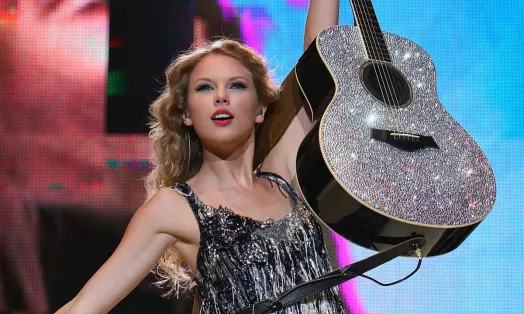
Taylor Swift has mastered the art of a cultural moment, and her latest album reveal proves it once again. In the stillness of the early morning, when most of the world was asleep, she strategically dropped a bombshell. At exactly 12:12 a.m., the pop superstar announced her 12th studio album, “The Life of a Showgirl.” The choice of timing was no accident. Swift’s fascination with certain numbers, particularly 12 and 13, has been well-documented over the years, and fans were quick to pick up on the symbolism. This wasn’t just a release update — it was a calculated event designed to stir excitement, speculation, and an immediate wave of online discussion.
What made this reveal even more surprising was the platform she chose. Instead of a flashy Instagram post, a carefully curated YouTube premiere, or a glossy magazine cover story, Swift opted to make the announcement on the New Heights podcast, hosted by NFL star Travis Kelce and his brother Jason. For fans of both worlds — pop music and American football — this was an unexpected crossover moment. The decision to align the reveal with a podcast appearance hinted at a deliberate strategy: to reach beyond her existing fanbase and tap into an entirely different audience demographic.
The audio clip itself was brief, but every second mattered. Swift’s words were measured, her tone excited yet controlled. She didn’t give away tracklists, lyrical snippets, or detailed concepts — at least, not overtly. But longtime Swifties know that with her, the smallest phrases can contain the biggest clues. From her choice of adjectives to her pauses, the podcast segment became immediate decoding material for online fan communities.
Preorders for “The Life of a Showgirl” went live moments after the announcement. In typical Swift fashion, there was more than just a digital download option. Physical formats were front and center: vinyl pressings in exclusive colors, CDs packaged with collectible posters, and even cassettes — a retro touch that caters to both nostalgia-driven collectors and younger fans who embrace vintage trends. The vinyl editions, in particular, are likely to sell out quickly given Swift’s track record of shattering sales records with each new release.
The shipping date is set for just before October 13, a timing that fans couldn’t ignore. October 13 is yet another nod to Swift’s lucky number 13, a number she has referred to as magical throughout her career. This layering of numerical symbolism is part of what makes Swift’s marketing so unique — it’s not just about the music, it’s about creating a mythology that fans feel deeply connected to.
The title itself — “The Life of a Showgirl” — has sparked intense curiosity. The phrase evokes images of glittering costumes, dramatic spotlights, and an almost cinematic life on stage. But behind the glamour lies the unrelenting dedication, the rehearsals, the sacrifices, and the constant public scrutiny. Swift has lived a version of this for nearly two decades. From her earliest days as a teenage country prodigy to her evolution into one of the most powerful forces in global pop culture, she has been both the performer in the spotlight and the architect behind the scenes.
Swift has always been a master storyteller. Each of her albums has been a self-contained era, complete with its own aesthetic, narrative arc, and sonic identity. With “The Life of a Showgirl,” there’s an expectation that she will lean into a more theatrical, perhaps even autobiographical approach — blending the spectacle of performance with the rawness of personal truth. It’s a balancing act she has performed before, but the title suggests this time it may be even more pronounced.
The decision to announce this album in connection with Travis Kelce adds another layer of intrigue. Swift and Kelce’s public interactions have been the subject of headlines, memes, and fan theories for months. Whether or not this is a direct nod to their rumored closeness, the choice undeniably amplified the announcement’s reach. Sports media picked up the story just as quickly as entertainment outlets, creating a rare crossover moment in cultural news cycles.
Fans wasted no time in theorizing about the album’s themes. Some believe “The Life of a Showgirl” could be a behind-the-curtain exploration of fame — the contrast between the glittering public image and the private struggles. Others speculate it could be a celebration of artistry, resilience, and the ability to reinvent oneself. Swift’s recent eras have explored nostalgia, self-reclamation, and storytelling from multiple perspectives; this new chapter could be her most self-aware yet.
Swift’s relationship with her fans is unlike any other in modern music. She doesn’t just release albums; she creates events. The careful placement of easter eggs in music videos, social media posts, and even her fashion choices keeps fans engaged in an ongoing treasure hunt. “The Life of a Showgirl” announcement was no different — from the exact time it dropped to the seemingly casual yet calculated choice of words, everything was designed to be dissected.
The marketing brilliance lies in how personal it all feels. Fans feel like they are part of an inner circle, privy to hints and winks that outsiders might miss. This connection is why Swift’s preorders often skyrocket within minutes, why her tour tickets sell out faster than industry averages, and why her physical album sales remain exceptionally strong in the age of streaming.
Swift’s history of album rollouts is filled with creative approaches. From the surprise drop of “Folklore” during the pandemic to the elaborate multi-version releases of “Midnights,” she has never repeated herself exactly. Each rollout feels fresh, tailored to the mood of the album, and engineered to maximize both emotional impact and commercial performance. “The Life of a Showgirl” seems poised to continue that tradition, blending intimacy with spectacle.
The showgirl concept also ties into a broader cultural history. Showgirls in entertainment have often been seen as glamorous figures, but their lives involve discipline, resilience, and constant reinvention. They are performers who understand that the show must go on, no matter the personal cost. For Swift, whose life has been a public performance in many ways, the metaphor is a powerful one.
This announcement also comes at a significant point in her career. She stands at a rare intersection of longevity and peak relevance. Few artists who debuted nearly 20 years ago can still dominate charts, headlines, and social media trends with such consistency. This album could be both a reflection on the journey so far and a statement of intent for the future.
Over the next few months, anticipation will build. Promotional campaigns, single releases, and perhaps even teaser performances are likely to keep “The Life of a Showgirl” in constant conversation. For fans, the wait will be an exercise in patience and detective work. For Swift, it’s another opportunity to prove why she remains not just a singer-songwriter, but one of the most astute cultural architects of her generation.
And this is just the beginning — the rollout has only started. If Swift’s past campaigns are any indication, the clues are already out there, hidden in plain sight, waiting for fans to connect them.