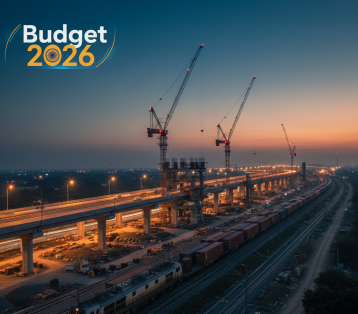
Infrastructure is once again the star of Budget 2026, with the government betting heavily on capital expenditure to drive growth, jobs and productivity. In a landscape where global uncertainty and domestic aspirations intersect, the Budget seeks to solidify India’s position as a fast-growing, infrastructure-led economy.
The central plank is a sizeable allocation for roads and highways, a sector that has seen sustained investment over recent years. Budget 2026 continues that trajectory with funding for expressways, economic corridors and last-mile connectivity. The focus is not only on building new assets but also on improving the quality and safety of existing networks. By connecting industrial hubs, agricultural belts and ports more efficiently, the government expects logistics costs to come down steadily.
Railways, too, feature prominently in the capital expenditure roadmap. Fresh allocations target three broad areas: safety upgrades, capacity expansion and modernisation. Investments in tracks, signalling and bridges are intended to increase reliability and reduce accidents. Meanwhile, dedicated freight corridors and modern rolling stock aim to increase the share of rail in both freight and passenger movement, easing pressure on roads and reducing emissions.
Ports, shipping and inland waterways remain important pieces of the logistics puzzle. Budget 2026 supports projects designed to improve port efficiency, multimodal connectivity and coastal shipping. By aligning port-led development with industrial corridors, policymakers hope to increase export competitiveness and attract manufacturing investments that rely on efficient throughput.
Urban infrastructure forms another crucial pillar of the Budget’s infrastructure story. Smart cities and metro rail projects continue to receive backing, with an emphasis on expanding coverage, improving commuter experience and integrating different modes of public transport. The idea is to reduce congestion, pollution and travel time in key urban centres while supporting the emergence of new economic clusters in tier-2 and tier-3 cities.
A particularly notable theme this year is the emphasis on integrated logistics. Budget 2026 advances the agenda of building multimodal logistics parks that bring together road, rail, air and waterways. Such hubs are envisioned as nodes that can handle cargo more efficiently, supported by digital tracking and simplified procedures. The expected outcome is a more resilient supply chain that can handle demand surges and disruptions without significant cost spikes.
Financing this expansive infrastructure agenda is a delicate balancing act. While the government has committed to a firm fiscal consolidation path over the medium term, it has chosen to prioritise productive capital expenditure over revenue spending where possible. This means that the quality of spending, not just the quantity, is being closely monitored. The Budget underscores the aim of leveraging every rupee of public capex to crowd in multiple rupees of private investment.
To that end, public–private partnerships and asset monetisation frameworks remain key tools. The government is looking to attract institutional investors, domestic and foreign, into brownfield and greenfield infrastructure projects via innovative structures. Infrastructure investment trusts, guarantees and viability gap funding are among the mechanisms being used to de-risk projects and make them more attractive to private capital.
The regional distribution of infrastructure projects is another area of policy attention. Budget 2026 stresses equitable development by ensuring that lagging regions receive targeted interventions in transport, power and social infrastructure. In practice, this may translate into new road links, railway connectivity and urban amenities in states and districts that have historically remained outside the main investment corridors.
Sustainability considerations are increasingly embedded in infrastructure planning. Energy-efficient designs, resilient materials and environmental clearances are being integrated into project lifecycles to reduce long-term ecological costs. Greenfield highways, for instance, are expected to incorporate better drainage, plantation drives and noise barriers where appropriate. Rail projects are aligning with electrification and renewable-powered operations.
From an economic standpoint, the government is banking on infrastructure to generate a strong multiplier effect. Every rupee spent on building roads, railways and urban systems is expected to feed into demand for steel, cement, machinery and services, as well as direct and indirect employment. Over the long term, lower logistics costs, smoother mobility and better urban amenities should enhance India’s competitiveness as a manufacturing and services hub.
For businesses, particularly in manufacturing, logistics, e-commerce and tourism, the Budget’s infrastructure thrust sends a clear message: the enabling physical backbone will continue to expand. Investors and companies planning large-scale projects often look at a multi-year horizon, and continuity in infrastructure emphasis across successive Budgets helps in long-term decision-making.
For citizens, the impact of these measures will be visible in the form of better roads, faster trains, expanded metro networks and more reliable city services. While large projects take time to complete, incremental improvements—shorter travel times on key stretches, reduced congestion at chokepoints and improved connectivity to emerging suburbs—often start showing up sooner.
In summary, Budget 2026 treats infrastructure as both a growth driver and a strategic asset. By locking in high-quality capital expenditure, leveraging private capital and aligning projects with logistics and urban needs, the government is attempting to create long-lasting economic value. The success of this strategy will hinge on timely execution, transparent processes and sustained policy support over multiple years.