India’s vision for next-generation connectivity took center stage at the India Mobile Congress (IMC) 2025 in New Delhi, where faculty from the Visvesvaraya National Institute of Technology (VNIT), Nagpur, demonstrated key innovations in 6G technology to Prime Minister Narendra Modi. The presentation marked a major milestone in India’s progress toward realizing its Bharat 6G Mission, positioning the nation at the forefront of global telecom research.
Among the highlights of the showcase was Reconfigurable Intelligent Surface (RIS) technology — a breakthrough that allows wireless signals to be dynamically controlled and redirected using smart surfaces. This technology has the potential to dramatically enhance connectivity, reduce signal loss, and improve data transmission efficiency in dense urban environments.
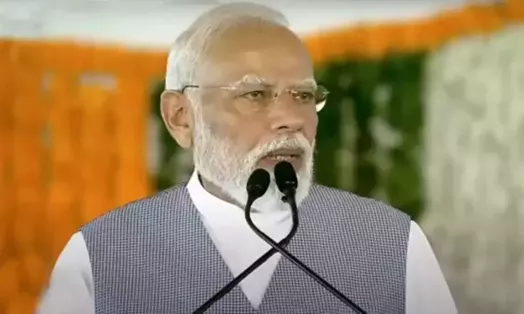
During the demonstration, PM Modi interacted with the research team from VNIT Nagpur and commended their efforts in advancing indigenous 6G capabilities. The Prime Minister emphasized that India’s focus on 6G is not just about faster internet speeds but about building a fully interconnected ecosystem that supports AI, robotics, IoT, and smart cities. He reiterated the government’s commitment to supporting homegrown innovation through initiatives like Atmanirbhar Bharat and the Digital India program.
VNIT’s demonstration also highlighted India’s collaboration with major telecom operators, startups, and academic institutions under the Telecom Technology Development Fund (TTDF). This fund supports applied research to bridge the gap between laboratory innovations and real-world implementation. The RIS system developed by VNIT is part of a broader ecosystem of technologies being designed to make India self-reliant in advanced communication networks.
Experts attending the IMC noted that India’s 6G roadmap focuses on sustainability, affordability, and scalability. Unlike the earlier transitions from 3G to 5G, the 6G initiative aims to integrate terahertz frequency communication, edge computing, and AI-driven network management, making India a potential hub for future digital infrastructure.
The India Mobile Congress 2025 featured participation from global telecom leaders, startups, and academic researchers. The event underscored how India is rapidly transforming from a consumer of technology to a producer and innovator, capable of shaping the global digital landscape.
In conclusion, the demonstration by VNIT Nagpur at the India Mobile Congress not only showcased India’s growing research strength but also reinforced the nation’s ambition to lead the 6G revolution. With strong governmental support and academic innovation, India is positioning itself as a pioneer in the evolution of next-generation communication technologies.