Here's a full detailed article:
India's AI Content Rules 2026: Everything You Need to Know
Introduction
February 20, 2026 is a date that every digital creator, social media user, journalist, marketer, and technology professional in India needs to remember.
Because today, the Indian government officially enforced one of the most significant regulatory changes in the history of digital content in this country.
The Ministry of Electronics and Information Technology — commonly known as MeitY — has amended the IT (Digital Media Ethics Code) Rules 2021. And with this amendment, India has taken a bold, decisive, and long-overdue step toward governing AI-generated content.
This is not a guideline. This is not an advisory circular. This is enforceable law — with real legal consequences for those who violate it.
But what exactly does this law say? Who does it affect? What changes for creators, platforms, and everyday users? And most importantly — will it actually work?
This article breaks it all down. In complete detail.
The Background: Why Did India Need These Rules?
To understand why these rules matter, you first need to understand the problem they are trying to solve.
Artificial Intelligence has democratized content creation in a way the world had never seen before. Today, anyone with a smartphone and an internet connection can generate hyper-realistic images, clone a person's voice, create fake videos of real people, and distribute that content to millions within minutes.
This is both the miracle and the menace of modern AI.
In India specifically, the consequences have been deeply alarming.
Deepfake videos of political leaders have been used to spread misinformation during elections. AI-generated audio clips of celebrities have been used to run fraudulent financial schemes. Synthetic images have been used to target women, create non-consensual intimate content, and destroy personal reputations. Fabricated news content — designed to look completely real — has spread communal tension and public panic.
And through all of this, the legal framework remained largely silent. There were no clear definitions. No specific obligations. No enforceable standards for platforms or users.
That silence ends today.
What Exactly Are These New Rules?
MeitY first notified this amendment on February 10, 2026. After a 10-day window, the rules came into full effect today.
The amendment is built around a new concept called Synthetically Generated Information — or SGI.
SGI is defined as any computerized content that has been generated or significantly modified by AI or computer algorithms — and that appears to depict a real person, a real event, or a real location.
This definition is the foundation of the entire regulatory framework. Everything flows from it.
The 3 Major Changes That Define This Amendment
Change 1: Mandatory Labeling of AI-Generated Content
This is the most direct and immediately impactful change for creators and users.
If you create or share any content that qualifies as SGI — any image, video, audio, or text generated or significantly altered by AI — you are now legally required to label or watermark it before posting it online.
The label must be clear, visible, and permanent. Once applied, it cannot be removed under any circumstances.
The purpose is straightforward — every person who encounters AI-generated content online must be able to immediately identify it as such. The days of AI content passing off as reality without disclosure are over.
However, the rules do provide a reasonable exemption. Basic photo editing — adjusting brightness, cropping, color correction — does not qualify as SGI. You do not need to label a photograph just because you ran it through a standard editing filter. The law is targeting synthetic generation and significant AI-driven modification — not routine editing.
Change 2: Dramatically Increased Platform Accountability
This is where the rules get serious for the big technology companies.
Social media platforms operating in India — Meta, YouTube, X, Snapchat, ShareChat, and every other intermediary — now face a completely new set of obligations.
Takedown window slashed from 36 hours to 3 hours. When MeitY or a competent authority directs a platform to remove a piece of content, the platform now has just 3 hours to comply. Previously, they had 36 hours. That is a twelve-fold increase in urgency — and it signals that the government is done tolerating slow responses to harmful content.
Mandatory AI detection tools. Platforms must now develop and deploy technical tools capable of verifying whether user-uploaded content is AI-generated before it goes live. This is a significant technical obligation. It means platforms can no longer claim passive ignorance about the nature of content on their networks.
Quarterly user warnings. Every three months, platforms must send all their users a formal warning about the legal consequences of AI misuse. This is designed as a continuous awareness mechanism — not a one-time notification buried in terms and conditions.
Platform-specific content coding. Platforms must implement a coding system that embeds the origin information into AI-generated content — so that any synthetic content can be traced back to the platform or tool that created it. This is a major step toward establishing a chain of accountability for AI content.
Response timeline for child safety content reduced to 12 hours. For any content involving violence or obscenity related to children, platforms must respond within 12 hours. There is zero tolerance and zero delay expected in this category.
Change 3: A Clearly Defined No Go Zone
The amendment explicitly identifies categories of content that are completely prohibited — regardless of context, intent, or platform.
These include:
Obscene content involving children. Any AI-generated content that sexualizes minors is an absolute red line. No exceptions, no defenses.
Fake documents and fabricated electronic records. Using AI to generate counterfeit government documents, identity proofs, financial records, or any official electronic records is now explicitly banned.
Weapons and ammunition information. AI-generated content that provides information related to illegal weapons, explosives, or ammunition falls under this prohibited category.
Deepfake photos and videos. Any synthetically generated visual content that places a real person in a situation, environment, or context they never actually experienced — without their consent — is banned.
What Are the Legal Consequences of Violation?
The government has not left enforcement to imagination. The amendment clearly specifies the legal framework under which violations will be prosecuted.
Violations of the SGI rules will invite action under three major legal instruments:
Bharatiya Nyaya Sanhita (BNS) — India's new criminal code, which replaced the Indian Penal Code in 2024.
Bharatiya Nagarik Suraksha Sanhita (BNSS) — The code governing criminal procedure in India.
POCSO Act — The Protection of Children from Sexual Offences Act, which carries some of the most stringent penalties in Indian law.
The government has also clarified one important technical point — platforms that use automated tools to proactively detect and remove SGI content will not be considered in violation of Section 79 of the IT Act, which provides safe harbor protections to intermediaries. In other words, platforms that do the right thing proactively will be protected, not penalized.
The Summit Context: Why Today Matters Even More
The timing of this enforcement is not coincidental.
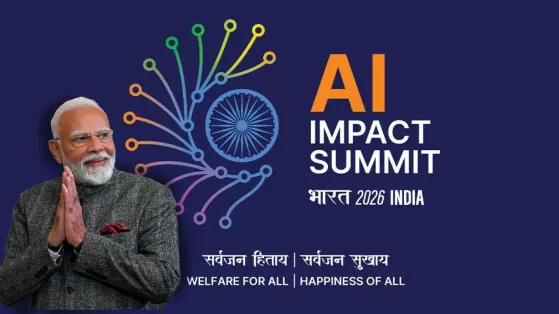
Today, India is hosting the India AI Impact Summit at Bharat Mandapam in New Delhi — the first AI summit of this scale to be held in a developing country.
Prime Minister Narendra Modi addressed the summit and spoke directly about the dangers of deepfakes and fabricated content. He called for clear watermarking standards, transparent source identification, and greater global vigilance around online child safety.
Leaders from across the world — including French President Emmanuel Macron, OpenAI CEO Sam Altman, and Google CEO Sundar Pichai — are in attendance.
Mukesh Ambani announced a ₹10 lakh crore investment in AI infrastructure over the next seven years.
India is sending a message to the world — we are not just a consumer of AI. We are a regulator, an innovator, and a responsible leader in the global AI ecosystem.
Enforcing these rules on the same day as this summit is a deliberate and powerful statement of intent.
What This Means For You — Practically
If you are a content creator: Before posting any AI-generated image, video, or audio — label it. Make it visible. Make it clear. Do not assume the platform will do it for you. The legal responsibility starts with you.
If you are a marketer or brand: Review every piece of AI-assisted creative content in your pipeline. Ensure your agency partners and production teams understand these obligations. A missed label is no longer just an ethical oversight — it is a legal liability.
If you are a journalist or media professional: The bar for verification just got higher. AI-generated content in news contexts must be identified and disclosed. Your credibility — and your legal standing — depends on it.
If you are a social media platform: Your 36-hour comfort window is gone. Build the detection tools. Set the quarterly reminders. Implement the coding systems. The regulatory scrutiny on platforms in India is only going to increase from here.
If you are an everyday user: Be aware. Before you share that viral video or that shocking image — ask yourself whether it could be AI-generated. The new rules protect you as much as they regulate others.
The Bigger Picture: India's Responsible AI Ambition
These rules represent something far larger than a regulatory amendment.
They represent India's emerging philosophy on AI governance — one that says innovation and responsibility are not opposites. They are partners.
For too long, the global conversation on AI has been dominated by two extremes. On one side, unchecked innovation with no guardrails. On the other, excessive regulation that stifles creativity and progress.
India is attempting to chart a third path — one where AI is democratized, accessible, and powerful, but where its misuse carries clear and enforceable consequences.
This is the same vision that PM Modi articulated at the AI Impact Summit today. This is the same ambition that Mukesh Ambani echoed when he spoke of building sovereign AI infrastructure for every Indian citizen.
The question is not whether India has the vision. It clearly does.
The question is whether India has the execution infrastructure to match that vision.
The Honest Challenges Ahead
No analysis of this regulation would be complete without acknowledging the very real challenges that lie ahead.
Awareness gap. The vast majority of India's 800 million internet users have no idea these rules exist. Enforcement without awareness will only criminalize the uninformed, not protect society.
Technical capacity. AI detection is an imperfect science. The tools required to reliably identify AI-generated content at scale do not yet exist in a fully reliable form. False positives will be a genuine problem.
Platform compliance. Major global platforms have historically been slow to comply with Indian regulatory requirements. Whether the 3-hour takedown window will be genuinely enforced — or quietly ignored — remains to be seen.
Small creator burden. A solo creator working with AI tools for creative expression faces the same labeling obligations as a major media house running deepfake propaganda. The rules do not differentiate — and that may need refinement over time.
Regulatory capacity. MeitY is a capable ministry, but governing AI content at the scale of Indian social media usage will require significant additional resources, personnel, and technical expertise.
The Right Step. But Only The First Step.
India has done something important today.
It has said — clearly, legally, and publicly — that AI-generated content is not a free-for-all. That synthetic information carries real responsibility. That platforms, creators, and users all have a role to play in ensuring that AI serves society rather than deceives it.
That is worth acknowledging and applauding.
But regulation is only as powerful as its enforcement. And enforcement is only as effective as public awareness.
The rules are in place. The framework exists. The intent is right.
Now comes the harder part — making it actually work.
India wants to lead the world in AI. And on the evidence of today, it is serious about that ambition.
The world is watching — not just to see how India builds with AI, but how India governs it.
That governance begins today.
Written from a media and technology perspective. All information referenced from MeitY's official amendment notification and coverage of the India AI Impact Summit 2026.