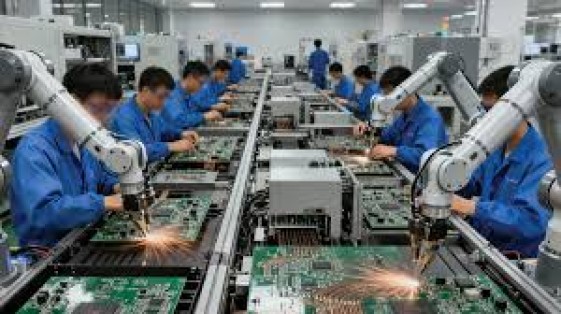
Haryana Targets ₹10,000 Crore Electronics Manufacturing Investments
Backed by a new ESDM policy, a 500-acre cluster at IMT Sohna, and central incentives, Haryana is pitching itself as India's next electronics hub to global manufacturers.
By Naina, 24th June 2026
Haryana is targeting around ₹10,000 crore in electronics manufacturing investment as it moves to position itself among India's leading destinations for high-value electronics production. The push is anchored by the state's new Electronics System Design and Manufacturing (ESDM) Policy 2026, notified in late May, and a flagship manufacturing cluster planned at IMT Sohna. By layering generous state incentives on top of the central government's electronics schemes, Haryana is courting both domestic and global manufacturers at a time when companies are diversifying supply chains and India is racing to build a deeper electronics ecosystem.
The timing is deliberate. India's electronics manufacturing has grown roughly sixfold over the past decade and is now among the country's fastest-growing export categories, drawing a wave of investment under national schemes. Haryana, which already contributes well above its share to national output despite its small size, wants a larger slice of that growth. The state's strategy combines fiscal incentives, world-class infrastructure, and faster approvals to compete with established hubs. Here is what the plan involves and what it means for investors.
The Investment Target
At the heart of the effort is a clear ambition to draw major electronics investment, with the state aiming for a figure in the order of ₹10,000 crore as it builds out the sector. The goal sits within Haryana's far larger 'Make in Haryana' Industrial Policy 2026, which targets ₹5 lakh crore in total investment and ten lakh jobs over five years across electronics, semiconductors, data centres, and advanced manufacturing. Electronics is a priority pillar of that vision, reflecting both the sector's growth and Haryana's proximity to the National Capital Region's talent and infrastructure.
The ESDM Policy 2026
The centrepiece is the Electronics System Design and Manufacturing Policy 2026, notified on 27 May and valid for five years. It offers a deep menu of incentives: reimbursement of 20 to 30 percent of eligible capital expenditure up to ₹200 crore per unit, operational-expense support of 50 to 80 percent for ten years, and relocation grants for units shifting to the state. The policy covers everything from mobile devices and IT hardware to semiconductors and IoT systems, and adds export-linked incentives and support for patents, signalling that Haryana wants both manufacturing and design to take root.
The IMT Sohna Cluster
Infrastructure is central to the pitch. The policy's anchor is a world-class Electronics Manufacturing Cluster planned at IMT Sohna, spanning roughly 500 acres with plug-and-play facilities, research and development centres, and dedicated testing infrastructure. The site sits on the Kundli-Manesar-Palwal Expressway, giving it strong connectivity to the wider region and ports. By offering ready industrial land and shared facilities, Haryana aims to cut the time and cost of setting up, a frequent pain point for manufacturers and a key factor in competing with rival states.
The National Tailwind
Haryana's push rides a powerful national wave. The Centre's Electronics Components Manufacturing Scheme, with an enhanced outlay in the latest budget, has already drawn investment commitments far above its initial target, and its approvals span eight states including Haryana. The scheme aims to build a domestic components ecosystem and support India's goal of $500 billion in electronics production by the end of the decade. Haryana is layering its own top-up incentives on these central benefits to make itself more attractive to scheme-approved investors.
The Investments Already Landing
Momentum is visible on the ground. Under the central components scheme, an advanced component manufacturing operation is being established in Haryana that is expected to create thousands of jobs, signalling that the state is already capturing a share of the national pipeline. Alongside, the broader 'Make in Haryana' launch drew large memorandums of understanding across sectors, including major data-centre commitments. These early wins give the electronics target credibility and suggest the policy framework is beginning to translate into concrete projects.
The Competitive Landscape
Haryana is not alone in the race. States such as Tamil Nadu, Gujarat, Uttar Pradesh, Andhra Pradesh, and Karnataka have aggressive electronics policies and existing clusters, and many already host marquee manufacturers. Haryana's pitch rests on its NCR location, skilled workforce, connectivity, and faster, AI-enabled clearances through a single-window system. To stand out, the state has matched or exceeded rival incentive structures, but converting policy promises into operating factories, against well-established competitors, will be the real test.
The Global Supply-Chain Angle
The wider backdrop is the global reshuffling of electronics supply chains. As companies diversify production away from a single dominant manufacturing base, India has emerged as a favoured alternative, and states are competing to host that relocating capacity. Haryana's relocation grants and export incentives are aimed squarely at this opportunity, hoping to attract international firms looking for a stable, cost-competitive base. Success would integrate the state more deeply into global value chains and lift its profile beyond its traditional automobile and services strengths.
The Risks and the Reality
Ambition comes with caveats. Investment targets and signed memorandums do not always convert into operating plants, and electronics manufacturing is capital-intensive with thin margins and fierce global competition. Haryana must deliver reliable power, skilled labour, and genuinely fast approvals to keep investors, not just attract them. Land acquisition, infrastructure execution, and competition from states with a longer track record all pose risks. The ₹10,000 crore figure is a target and a signal of intent, and its credibility will rest on how many projects actually break ground.
The Road Ahead
Haryana's drive to attract around ₹10,000 crore in electronics manufacturing investment marks a clear bid to join India's front rank of electronics hubs. The combination of a detailed ESDM policy, a dedicated cluster at IMT Sohna, central scheme support, and early project wins gives the strategy a solid foundation. Whether it succeeds will depend on execution and on how Haryana fares against entrenched rivals. With a global supply-chain shift in its favour and a national policy tailwind at its back, the state has a genuine opening, if it can turn incentives into operating factories. This is analysis, not investment advice.
Frequently Asked Questions
What is Haryana's electronics manufacturing target?
Haryana is aiming to attract major electronics investment, with a target in the order of ₹10,000 crore, as part of its push to become a leading electronics hub under its new ESDM Policy 2026 and the wider 'Make in Haryana' framework.
What is the Haryana ESDM Policy 2026?
Notified on 27 May 2026 and valid for five years, it offers incentives including up to 30 percent capital-expenditure reimbursement (capped at ₹200 crore per unit), operational-cost support, relocation grants, and export and patent incentives across electronics and semiconductors.
What is the IMT Sohna cluster?
A planned Electronics Manufacturing Cluster of around 500 acres with plug-and-play facilities, R&D, and testing infrastructure, located on the Kundli-Manesar-Palwal Expressway for strong regional connectivity.
How does this connect to central schemes?
Haryana is adding state-level top-up incentives on top of the Centre's Electronics Components Manufacturing Scheme, which has drawn large investment commitments nationally and supports India's $500 billion electronics production goal.
What are the main challenges?
Converting targets and memorandums into operating factories, delivering reliable power, skilled labour, and fast approvals, acquiring land, and competing with established electronics states like Tamil Nadu, Gujarat, and Uttar Pradesh.