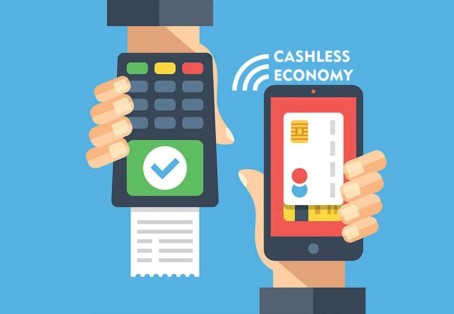
By NAINA | May 12, 2026 | Digital Economy, Payments, Global Finance
Money is one of humanity's oldest technologies. From cowrie shells and metal coins to paper notes and plastic cards, every evolution in the form of money has reshaped how economies function, how power is distributed, and who gets to participate in economic life. We are now living through the most consequential monetary transition since the invention of paper currency — the shift from physical cash to digital payment systems so seamless, so embedded in daily life, that the act of handing over a note or coin is becoming, for billions of people, a relic of another era.
The numbers that define this transition are extraordinary. Global digital payment transaction value is projected to hit $20.09 trillion in 2025. By 2030, Statista expects total transaction values to grow at 7.63% annually, reaching $36.09 trillion. As of 2025, 85% of global point-of-sale transactions are cashless. In Sweden, only 10% of transactions use physical cash, and that figure is expected to fall to 0.5% by year-end. China leads the world with 91% of urban transactions conducted via digital platforms — WeChat Pay, Alipay, and the state-backed digital yuan. India's UPI ecosystem processed transactions worth ₹1,536 lakh crore in the first half of 2025 alone, representing 97.7% of the country's total payment transaction value. The mobile wallet market is projected to reach $16.2 trillion by 2031, with 4.8 billion users — nearly 60% of the global population — already using mobile wallets in 2025.
These are not projections from a distant future. They are the architecture of the present — a global payment ecosystem that has already crossed the threshold from cash-dominant to digital-dominant in most of the world's major economies. And yet the transition to a fully cashless society is neither inevitable nor uncomplicated. Sweden and Norway — the two countries furthest along the cashless path — both backtracked in 2024, with Sweden's Ministry of Defence issuing brochures advising citizens to use and stock physical cash, and Norway passing legislation authorising fines for retailers who refuse it. The Federal Reserve's 2025 Diary of Consumer Payment Choice found that over 85% of Americans favour laws requiring businesses to accept cash, while 84% oppose a fully cashless society.
The future of cashless societies is not a simple trajectory from physical to digital. It is a complex, contested, and geographically uneven transformation that carries profound implications for financial inclusion, monetary sovereignty, privacy, security, and the balance of power between states, corporations, and individuals. This article examines that transformation in full — the data, the geographies, the technologies, the risks, and the policy choices that will determine what kind of cashless future the world actually builds.
The Global Cashless Transition: Where the World Stands in 2026
The cashless transition is real, accelerating, and deeply uneven — and understanding those three characteristics simultaneously is essential to reading the global payments landscape accurately.
The acceleration is visible in every major market. In the euro area, contactless payments reached 29.6 billion in H1 2025 alone, up 12.8% year-over-year. Contactless represented 83% of all in-person card payments, and 93% of POS terminals accepted contactless by mid-2025. In the UK, the Faster Payment System processed 5.09 billion transactions worth £4.2 trillion in 2024. In Indonesia, the QRIS digital payment system saw a 226.5% surge in transactions in 2024. Japan exceeded its government target of 40% cashless transaction rate, reaching 42.8% in 2024, and promptly accelerated its payment infrastructure modernisation programme, including CBDC pilots. Australia mandated cash acceptance for essentials starting in 2026 — a regulation that itself reflects the speed at which cash has retreated from everyday transactions, forcing governments to actively legislate cash's survival.
The unevenness is equally important. Asia-Pacific leads the world in cashless adoption, with 85% of adults in urban areas using cashless methods. But that headline number conceals enormous internal variation. China's urban digital payment penetration is one of the highest in the world; rural China and lower-income populations within Chinese cities are far less comprehensively served by the digital payment ecosystem. India's UPI has achieved remarkable penetration by global standards — 97.7% of payment transaction value in digital form — but that figure is weighted toward higher-value transactions, and a significant portion of India's rural and lower-income population still relies primarily on cash for daily transactions.
Africa presents a third pattern entirely. The continent has largely skipped the credit card stage of payment infrastructure development, moving directly from cash to mobile money — a model pioneered by M-Pesa in Kenya, which now processes over 50 million transactions monthly and serves as the primary financial infrastructure for populations that never had access to traditional banking. This leapfrog model is significant for what it reveals about the relationship between cashless adoption and financial infrastructure: the most impactful digital payment innovations in emerging markets are not adaptations of systems developed for the Western banking ecosystem, but purpose-built platforms designed for the specific constraints and opportunities of their markets.
In North America, the cashless transition is advancing but meeting more resistance than in Europe or Asia. In the United States, total digital payment transaction value was $3.07 trillion in 2024, projected to reach $3.15 trillion in 2025 and $3.5 trillion by 2026. Ninety percent of Americans used some form of digital payment in 2025. But the Federal Reserve's payment diary data also reveals that 80% of Americans still carried cash in their wallets at least one day a month — and over 85% favour laws requiring businesses to accept it. The U.S. payment culture is bifurcated: digitally sophisticated in its adoption of mobile wallets and contactless payments, but deeply resistant to the idea of a formally cashless society.
The Technology Stack: What Is Actually Driving Cashless Adoption
The cashless transition is not driven by a single technology. It is driven by a layered technology stack — mobile devices, real-time payment infrastructure, digital wallets, contactless payment standards, and increasingly, AI-powered fraud detection and biometric authentication — that together make digital payment so convenient, secure, and ubiquitous that cash simply cannot compete on user experience.
The smartphone is the foundational layer. The ability to carry the equivalent of a fully functional bank in a pocket device has democratised financial access in ways that previous payment innovations could not. Mobile payment apps are expected to serve 3.2 billion users globally by 2025, and digital wallets accounted for 49% of all e-commerce payments and 32% of point-of-sale payments globally in 2023, with both figures expected to cross 52% and 39% respectively by 2026. The Transparency Market Research study projects the mobile wallet market will reach $16.2 trillion by 2031 — a figure that reflects not just consumer adoption but the integration of mobile payment infrastructure into the entire commercial ecosystem.
Real-time payment infrastructure is the second critical layer. The ability to transfer money instantly — not in hours or days, but in seconds — fundamentally changes the use case calculus for cash. Cash's primary practical advantage over digital payment has historically been immediacy: you hand over a note and the transaction is complete. Real-time payment systems like India's UPI, the UK's Faster Payments, and the euro area's instant credit transfer system eliminate this advantage. When digital payment is as fast as cash — and more secure, more traceable, and more convenient — the remaining arguments for cash in everyday transactions diminish substantially.
Contactless payment technology — Near Field Communication (NFC) — has been the critical enabler of cashless adoption at the physical point of sale. The pandemic of 2020–2021 was the accelerant: fear of virus transmission via cash handling pushed businesses and consumers to adopt contactless at a pace that years of marketing had failed to achieve. By 2025, contactless represents 83% of all in-person card payments in the euro area, and 93% of terminals accept it. The checkout experience — tap, beep, done — is now faster and simpler than handling cash for any transaction under a certain value, removing the last meaningful friction point in retail digital payment adoption.
Biometric payment technology is the emerging next layer. Biometric payments represented 5% of digital transactions in 2023 and are projected to double by 2025. Fingerprint recognition, facial authentication, and vein pattern scanning are being integrated into payment terminals, enabling transactions that require no device — just the person. This represents the logical endpoint of frictionless payment: a transaction executed by the customer's physical presence alone, with identity and authorisation handled by biological verification. The commercial and privacy implications of this development are substantial and are discussed in the risk analysis section of this article.
AI is now deeply embedded in the cashless payments ecosystem — not as a visible feature but as an operational layer that makes the system trustworthy at scale. Fraud detection algorithms that analyse transaction patterns in real time, anomaly detection systems that flag unusual payment behaviour before it causes losses, and personalised financial management tools that help users understand and control their digital spending are all AI-powered capabilities that make cashless systems safer and more useful than their cash equivalents in critical respects.
India and China: The Two Models That Are Defining the Global Future
No two countries have done more to define what a cashless society actually looks like in practice than India and China — and their models are strikingly different in architecture, governance, and social implications.
India's cashless revolution is built on UPI — the Unified Payments Interface — a real-time payment platform developed by the National Payments Corporation of India that enables instant bank-to-bank transfers using mobile phone numbers or virtual payment addresses. UPI is one of the most consequential financial infrastructure innovations of the past decade. In the first half of 2025, UPI-based transactions reached ₹1,536 lakh crore, representing 97.7% of India's total payment transaction value. The system processes billions of transactions monthly and has achieved adoption rates that rival the most developed cashless economies in the world — not despite India's development challenges, but partly because of them. UPI's design deliberately accommodated the constraints of the Indian market: it works on basic smartphones, requires no proprietary hardware at the point of sale, and integrates with existing bank accounts rather than requiring users to adopt new financial products.
India is now layering the Digital Rupee — its Central Bank Digital Currency — onto the UPI infrastructure. By December 2025, the RBI had recorded approximately 8 million CBDC retail users with 19 banks authorised to distribute the e-Rupee. The digital rupee in circulation rose to ₹10.16 billion by March 2025, up 334% from ₹2.34 billion in 2024, making India's e-Rupee the second-largest CBDC pilot in the world. Cumulative CBDC-R transaction value exceeded $3 billion by end of 2025. The e-Rupee is fully interoperable with UPI — users can transact between traditional bank accounts and CBDC wallets using familiar UPI apps — a design choice that dramatically reduces the adoption friction that has limited CBDC uptake in other markets. As one analysis frames it: UPI is the highway, and the CBDC is the vehicle.
China's model is different in both architecture and scale. The digital payments ecosystem in China was not built by the government — it was built by Alibaba's Alipay and Tencent's WeChat Pay, which together achieved dominance of Chinese digital commerce well before the state developed its own CBDC. With 91% of urban transactions conducted via these platforms, China has arguably the most comprehensive real-world cashless system in any large economy. The Digital Yuan (e-CNY), the state-backed CBDC, is layered on top of this existing infrastructure — by June 2024, total e-CNY transaction volume had reached 7 trillion yuan ($986 billion) in 17 provincial regions, across sectors including education, healthcare, and tourism. This figure is nearly four times the transaction volume recorded just a year earlier, reflecting the acceleration of state-directed adoption.
China's model raises questions that extend beyond payments efficiency. The ability of Alipay and WeChat Pay to monitor citizens' spending habits in granular detail — and the integration of those platforms with China's social credit system and broader state surveillance apparatus — has made China's cashless model a reference point in global debates about the relationship between digital payment adoption and state control. Purchases of books, political donations, or services deemed "sensitive" can be detected and flagged through the digital payment record. This is not hypothetical — it is documented. Understanding China's cashless model requires confronting simultaneously its genuine efficiencies and its genuine risks.
CBDCs: The State Reclaims Monetary Sovereignty
Central Bank Digital Currencies represent the most consequential development in global monetary architecture since the Bretton Woods system — and they are advancing from experiment to implementation at a pace that has surprised even the institutions designing them.
The Atlantic Council's CBDC tracker recorded 134 countries exploring or implementing CBDCs as of 2025 — representing 98% of global GDP. The Bahamas launched the world's first nationwide CBDC, the Sand Dollar, in 2020. Nigeria launched the eNaira the same year. China's Digital Yuan is the largest CBDC pilot by circulation and transaction volume. India's e-Rupee is the second largest. The EU Digital Euro is in design phase. The Bank of England is advancing its digital pound work. Australia is exploring wholesale CBDC through Project Acacia. Even the United States — historically the most cautious major economy on CBDC — is seeing evolving regulatory architecture under the CLARITY Act of 2025.
The policy rationale for CBDCs is multi-dimensional and varies by country. For emerging economies, the primary motivation is financial inclusion: a CBDC with lower KYC requirements than traditional banking accounts can extend access to the formal financial system to populations that have been excluded by the documentation and infrastructure requirements of conventional banking. India's e-Rupee explicitly targets this use case — its token-based design grants it the potential to function with lower KYC requirements for those not included in the banking system, offering a pathway to financial participation for populations that UPI has not yet reached.
For advanced economies, the motivations are different. The rise of private stablecoins — digital tokens pegged to national currencies but issued by private companies rather than central banks — represents a genuine threat to monetary sovereignty. If a significant portion of economic activity migrates to stablecoins issued by technology companies, the central bank's ability to conduct monetary policy — to control the money supply, manage inflation, and provide lender-of-last-resort functions — is potentially compromised. CBDCs allow central banks to offer the programmability and digital convenience of stablecoins while maintaining state control over the monetary system.
Cross-border payment efficiency is a third motivation. Traditional correspondent banking for international payments is slow, expensive, and opaque. CBDC interoperability — the ability for CBDCs issued by different central banks to transact directly with each other — could dramatically reduce the cost and time of cross-border payments, with particular benefit for remittances that are currently subject to fees that represent a significant tax on the incomes of migrant workers. The Bank for International Settlements has been developing multi-CBDC platforms that enable cross-border interoperability, and several bilateral CBDC payment agreements between central banks are in various stages of development.
The wholesale CBDC application — interbank settlement, securities clearing, and repo transactions — is advancing faster than retail CBDC and with less controversy, because the privacy and surveillance concerns that complicate retail CBDC adoption are less acute in wholesale financial markets where institutional participants already operate under comprehensive regulatory reporting requirements. Australia's Project Acacia, which assesses blockchain benefits in interbank and tokenised asset markets, is representative of this approach.
Sweden's Paradox: The World's Most Advanced Cashless Economy Steps Back
No single country's cashless journey is more instructive — or more paradoxical — than Sweden's. The country that was on track to become the world's first fully cashless society has, in the past two years, executed a deliberate reversal that says as much about the limits of cashless as it does about its possibilities.
By 2025, only 10% of Swedish transactions use physical cash — a figure that is expected to fall to 0.5% by year-end. Sweden's Swish mobile app has 5 million users — in a country of 10 million people — enabling instant fund transfers through mobile numbers. IKEA's Swedish stores stopped accepting cash due to operational costs. For most Swedes, in most everyday transactions, cash has become not just inconvenient but practically unavailable.
And yet, in November 2024, Sweden's Ministry of Defence sent brochures to every home in the country advising citizens to use and stock cash and to diversify their payment methods. The reasoning was not financial or economic — it was strategic. In an era of increasing geopolitical tension, cyberwarfare, and infrastructure vulnerability, a society where 99.5% of transactions are digital is a society where a coordinated cyberattack, an electromagnetic pulse, or even a severe storm that takes down communications infrastructure can bring the entire payment system to a halt. Cash, for all its inconvenience, is the only payment method that works when the power is out and the internet is down.
Norway reached a similar conclusion and went further, passing legislation authorising fines and sanctions for retail shops that refuse cash — a remarkable policy reversal for a country that had been one of the most aggressive advocates of cashless adoption in the world. The OECD's 2025 paper on safeguarding consumer access to cash in the digital economy captures the institutional recognition of this risk: Sweden and Norway, countries that had been on track towards complete digitalisation of their payment systems, backtracked in 2024 over fears of national security threats.
Australia's 2026 mandate requiring cash acceptance for essential purchases reflects the same policy concern from a different direction: the recognition that as cash infrastructure declines — ATM networks shrink, bank branches close, cash handling capacity is reduced — certain populations face increasing barriers to accessing the payment system. The OECD research identifies that these barriers fall disproportionately on the elderly, people with disabilities, lower-income populations, and residents of rural and remote areas — precisely the groups that policy frameworks are supposed to protect.
Sweden's paradox is not a failure of the cashless vision. It is a necessary corrective — a recognition that resilience, equity, and security are values that cashless payment infrastructure must be designed to protect, not sacrificed in the pursuit of efficiency and convenience.
Financial Inclusion: The Promise and the Peril
The most contested claim in the cashless society debate is that digital payments promote financial inclusion — that by reducing the infrastructure barriers to financial participation, digital payment systems extend access to economic life for the 1.4 billion adults globally who remain unbanked. The evidence is mixed, and the honest assessment is that digital payment adoption promotes financial inclusion under some conditions and actively threatens it under others.
The M-Pesa model in Kenya, the UPI model in India, and the mobile money models that have proliferated across Sub-Saharan Africa represent the inclusion-positive case. These systems have extended access to payment services, credit, savings, and insurance to populations that the traditional banking system had left entirely unserved — not by replicating the bank branch model in digital form, but by building payment infrastructure that works on basic mobile phones without requiring existing bank accounts, and that is designed for the transaction sizes and usage patterns of lower-income populations.
The inclusion-negative case is equally documented. Research presented at the 2025 Computers and People Research Conference concluded that the global shift toward cashless payment systems presents a significant dark side: the risk of financial exclusion for those lacking smartphones, internet access, or digital literacy. This exclusion is most acute in developing regions, where infrastructure and socioeconomic barriers limit digital access — but it also exists within wealthy countries, particularly for elderly populations, people with cognitive disabilities, and those living in remote areas with limited connectivity.
In the United Kingdom, research has documented that 2.2 million people remain reliant on cash and 1.3 million do not hold an active bank account. The risk is not just inconvenience — it is effective exclusion from economic participation in environments where digital payment is becoming the default and cash acceptance is shrinking. Pockets of extreme financial exclusion are found in deprived communities; affluent suburban areas score consistently more favourably on financial access metrics. The cashless transition, if unmanaged, does not reduce the financial exclusion gap — it widens it.
The demographic dimension is significant. The elderly — who disproportionately prefer cash and have lower digital literacy — face particular challenges in cashless environments. The 2025 Federal Reserve Diary of Consumer Payment Choice found that over 80% of Americans still carried cash at least one day a month, and that preference for cash is strongly correlated with age. Businesses that stop accepting cash — as IKEA Sweden has done, as U.S. national parks including the Guadalupe Mountains Visitor Center have done — make a commercial decision that effectively excludes a segment of their potential customer base.
Policy responses to financial exclusion in cashless transitions are developing, but unevenly. The OECD promotes legal safeguards for cash access. Sweden and Norway legally require some businesses to accept cash. Australia mandates cash acceptance for essentials from 2026. These regulatory backstops reflect a growing policy consensus that the transition to digital payment cannot be left entirely to market forces — that governments have an obligation to ensure that the efficiency gains of cashless systems do not come at the cost of excluding the most vulnerable members of society.
Privacy, Surveillance, and the Digital Payment Footprint
Every digital transaction leaves a record. This is simultaneously one of the most powerful features of cashless payment systems — the ability to track, verify, and analyse financial flows — and their most significant threat to individual liberty.
Cash is anonymous by design. When a person buys a newspaper, a meal, or a book with physical currency, the transaction leaves no record beyond the temporary memory of the parties involved. No government, no corporation, no algorithm knows what was purchased, where, and when. This anonymity is not valued only by those with something to hide — it is a fundamental aspect of economic privacy that democratic societies have historically treated as a civil right. The ability to spend money without surveillance is part of what it means to be economically free.
Digital payment systems eliminate this anonymity entirely. Every transaction is a data point: the merchant, the amount, the time, the location, and increasingly the item purchased. This data is held by payment processors, banks, technology platforms, and — in CBDC systems — potentially by central banks and governments. The transition to cashless societies fundamentally alters the nature of financial privacy. Unlike cash transactions which remain anonymous, every digital payment creates a permanent, traceable electronic footprint.
China's experience makes the surveillance risk concrete rather than theoretical. The integration of Alipay and WeChat Pay data with China's social credit system and broader state surveillance apparatus has created an environment in which financial transaction data is used to monitor, evaluate, and in some cases penalise citizens based on their spending patterns. This is not a projection about where digital payment surveillance might lead — it is a documented reality in the world's most advanced cashless economy. Whether Western liberal democracies would implement comparable surveillance systems is a different question, but the technical infrastructure for doing so is built into any sufficiently comprehensive cashless payment system.
The cybersecurity dimension is equally serious. A cashless society is a society whose economic functioning depends entirely on the security of digital infrastructure. The Equifax data breach of 2017 exposed the personal information of 147 million people, including financial data. In a fully cashless society, such breaches could lead to direct financial losses at a scale that paper currency vulnerabilities — counterfeiting, theft — cannot approach. The attack surface of a cashless payment system — millions of endpoints, complex software stacks, cross-border data flows — is vastly larger than that of physical currency, and the consequences of a successful large-scale attack are more immediate and comprehensive.
These concerns are not arguments for abandoning the cashless transition. They are arguments for designing cashless systems with privacy and security as foundational requirements rather than afterthoughts. Zero-knowledge proof cryptography, which allows transaction compliance to be verified without exposing transaction details, represents one technical approach. Strong data protection regulation — the GDPR model in Europe — represents a regulatory approach. The most resilient cashless societies will be those that treat privacy as an economic right that digital payment infrastructure must protect, not an obstacle that it must overcome.
Stablecoins and the Private Money Revolution
Alongside the government-led CBDC story, a parallel revolution in private digital money is reshaping the global payment landscape — and creating a competitive dynamic between state monetary authority and private payment innovation that has no clear historical precedent.
The stablecoin market's transaction volume more than doubled to $47.6 trillion in 2025 — a figure that exceeds the annual transaction volume of Visa and Mastercard combined. Stablecoins — digital tokens pegged to fiat currencies and issued by private entities — have achieved this scale by solving a specific problem that both traditional payment systems and volatile cryptocurrencies fail to address: the ability to move dollar-denominated value instantly, globally, and at near-zero cost, without the settlement delays and correspondent banking costs of the traditional banking system.
USDC, Tether, and their emerging competitors are being used not just by crypto-native companies but by mainstream corporates for treasury management, by fintech companies for payment infrastructure, and by migrants for cross-border remittances. Mastercard is developing a blockchain-based platform described as a "Venmo of crypto" — an indication that the largest traditional payment networks are integrating stablecoin infrastructure rather than opposing it. SoFi launched a cross-border crypto remittance service, targeting the enormous global remittance market with a stablecoin-based alternative to the expensive, slow correspondent banking channels that currently dominate.
In the United States, stablecoin regulation is evolving with bipartisan legislation that would establish a federal framework for stablecoin issuance — a development that would significantly expand institutional comfort with stablecoin-based payment systems and potentially accelerate adoption in commercial and corporate payment applications. The passage of the CLARITY Act in 2025 has already created a more defined regulatory environment for digital assets generally, and stablecoin-specific legislation would complete the regulatory architecture that institutional payment users require.
The competitive tension between stablecoins and CBDCs is one of the most consequential dynamics in global monetary policy. Both offer digital, programmable money with near-instant settlement. The difference is governance: stablecoins are issued by private entities subject to financial regulation; CBDCs are issued by central banks with the full backing of sovereign monetary authority. For governments concerned about monetary sovereignty, the growth of private stablecoins represents a genuine challenge that CBDCs are partly designed to address. For users, the competition between private and state-issued digital money creates choice — and potentially, the discipline of competition — in a domain that has historically been a state monopoly.
The Geopolitics of Cashless: Digital Payments as Strategic Infrastructure
The global cashless transition is not just an economic story — it is a geopolitical one. Digital payment infrastructure has become a domain of strategic competition between major powers, with significant implications for monetary sovereignty, financial sanctions, and the architecture of the global economy.
The U.S. dollar's dominance of global trade and finance is partly a function of the dollar-denominated correspondent banking system through which most international payments flow. SWIFT, the messaging system that coordinates international bank transfers, is a dollar-centric infrastructure that the United States has used as an instrument of financial sanctions — cutting Russia off from SWIFT in 2022, for example, and restricting Iran's access before that. The development of alternative digital payment infrastructure — China's Cross-Border Interbank Payment System (CIPS), bilateral CBDC arrangements between countries seeking to reduce dollar dependence, and stablecoin payment rails that bypass traditional correspondent banking — is partly motivated by the desire to reduce vulnerability to U.S. financial sanctions.
China's Digital Yuan is explicitly designed with cross-border payment capability that reduces dependence on SWIFT and the dollar-based correspondent banking system. Countries in the Global South that have experienced the impact of U.S. financial sanctions — directly or indirectly — have a clear strategic incentive to develop alternative payment infrastructure, and China's CBDC provides a ready-made alternative that comes with the technical and diplomatic support of the world's second-largest economy.
For India, the internationalisation of UPI is both a commercial and a strategic objective. Enabling UPI transactions across borders — with Singapore, the UAE, France, and a growing list of other countries — extends India's payment infrastructure influence and reduces the dependence of cross-border transactions involving India on Western payment rails. The e-Rupee's interoperability with UPI positions India to participate in bilateral CBDC arrangements that could eventually create a network of non-dollar payment corridors among major emerging economies.
For businesses operating internationally in 2026, the geopolitical dimension of digital payment infrastructure is not abstract. The payment rails through which cross-border transactions flow, the regulatory frameworks that govern cross-border data and capital movements, and the sanctions regimes that can freeze access to payment systems are all increasingly shaped by the strategic competition between digital payment superpowers. Understanding which payment infrastructure your business depends on — and which geopolitical risks that dependence creates — is becoming a material consideration in international commercial strategy.
The Regulatory Landscape: Balancing Innovation and Protection
The regulatory architecture governing cashless payment systems in 2026 is more developed than at any previous point — but it remains uneven, contested, and in many jurisdictions, significantly behind the pace of technological change.
The European Union's Payment Services Directive 3 and the open banking framework it mandates represent the most comprehensive regulatory approach to digital payment governance among major economies. The EU's instant payment regulation — which requires all payment service providers to offer instant credit transfers at no higher cost than standard transfers — is normalising instant payment as a baseline expectation rather than a premium service. The EU AI Act's requirements for transparency and accountability in AI systems used in financial services are beginning to shape how payment fraud detection and credit scoring algorithms are designed and deployed.
In the United States, the passage of the CLARITY Act in 2025 established a clearer regulatory framework for digital assets and stablecoins that has reduced regulatory uncertainty for institutional adopters. The Federal Reserve's ongoing development of the FedNow instant payment system — which launched in 2023 and is gradually achieving adoption among U.S. financial institutions — represents the infrastructure foundation for the kind of real-time payment capability that other markets achieved years earlier.
India's regulatory approach — led by the RBI and the National Payments Corporation of India — has been notable for its proactive design of public digital infrastructure. The UPI framework, the e-Rupee design, and the broader India Stack of digital identity and payment infrastructure represent a model of government-led payment innovation that has been influential globally, particularly among emerging economies seeking a development pathway that is not dependent on Western or Chinese payment platforms.
The cash access legislation being adopted in Sweden, Norway, Australia, and elsewhere represents a distinct regulatory dimension: the protection of cash as a payment option against the market-driven erosion of cash infrastructure. This is genuinely new regulatory territory — governments legislating not to promote a payment innovation but to protect a payment option that the market is making commercially unviable. The policy reasoning is sound: ensuring that the efficiency gains of cashless systems do not come at the cost of excluding vulnerable populations requires active regulatory intervention, not market reliance.
What the World's Most Cashless Societies Tell Us About the Future
The countries furthest along the cashless adoption curve — Sweden, Finland, China, South Korea, the Netherlands — offer the most direct evidence about what a mature cashless society actually looks like in practice. Several consistent patterns emerge from their experience.
First, the cashless transition does not eliminate financial exclusion — it relocates it. The populations that were most excluded from the traditional banking system often face equivalent or greater barriers in the digital payment system, unless specific design choices are made to include them. The M-Pesa and UPI models demonstrate that inclusion-positive design is possible; it is not automatic.
Second, the resilience argument for cash does not disappear with adoption. Sweden's reversal on cash is the most prominent illustration, but the broader point is consistent across multiple markets: the more comprehensively digital a society's payment infrastructure becomes, the more significant the vulnerability created by digital infrastructure failure. Resilient cashless societies need resilient payment infrastructure — redundancy, offline capability, and maintained cash access as a backup system — not the elimination of cash.
Third, the privacy implications of cashless payment systems require proactive governance to prevent their most problematic manifestations. The distinction between Sweden's open banking model, where data governance regulations protect individual privacy rights, and China's integrated surveillance model, where payment data feeds state monitoring systems, is not primarily technological. It is political and regulatory. The kind of cashless society a country builds reflects choices about power, privacy, and the relationship between state and citizen that no technology determines on its own.
Fourth, the competitive dynamics of the cashless ecosystem tend toward concentration. The network effects of payment platforms — where the value increases with the number of users — create winner-take-most dynamics that can produce duopolies or near-monopolies. Alipay and WeChat Pay in China, UPI platforms in India, and the Visa-Mastercard duopoly in card payments all illustrate how payment infrastructure markets concentrate. Regulatory frameworks that prevent this concentration from becoming extractive — that maintain competition, interoperability, and fair access to payment rails — are as important as those that promote innovation.
Building the Cashless Society Worth Having
The cashless society is not coming — it has largely arrived. In most of the world's major economies, the majority of economic transactions by value are already conducted digitally. The infrastructure of cashless payment — mobile wallets, real-time payment systems, contactless terminals, CBDCs — is being built and deployed at a pace that makes the direction of travel irreversible.
What is not determined is the quality of the cashless society that is being built. A cashless society can be one that extends financial participation to populations previously excluded by the barriers of traditional banking — or one that creates new barriers for those without smartphones, internet access, or digital literacy. It can be one that protects individual financial privacy through strong data governance — or one that enables unprecedented financial surveillance by states and corporations. It can be one that is resilient in the face of cyberattacks, infrastructure failures, and geopolitical disruptions — or one that is catastrophically vulnerable to any of them.
These are not technical questions. They are political, regulatory, and moral ones. The technology of cashless payment is largely mature. The governance of cashless payment — the frameworks for inclusion, privacy, resilience, and accountability that will determine what the cashless transition means for ordinary people — is the unfinished work of this decade.
The countries and institutions that get this governance right will build cashless societies that genuinely serve the economic lives of all their citizens. Those that prioritise efficiency and convenience over equity and security will build cashless systems that are impressive in their technical sophistication and deeply problematic in their social consequences. The data, the deployments, and the early reversals from Sweden to Norway to Australia all point toward the same conclusion: the future of cashless is not a technology problem. It is a governance challenge. And it is one that the world has only just begun to take seriously.