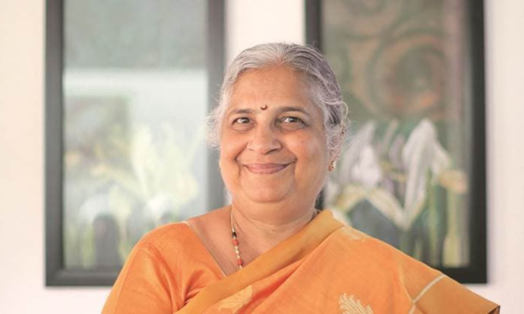
Sudha Murty – The Heart of Infosys Foundation
and Beyond
Introduction
In the ever-evolving narrative of India’s rise in the fields of technology, business, and philanthropy, one name resonates with compassion, intellect, and determination—Sudha Murty. Known widely as the chairperson of Infosys Foundation and the wife of Infosys co-founder N.R. Narayana Murthy, Sudha Murty’s identity goes far beyond these associations. She is a teacher, engineer, author, philanthropist, and above all, a compassionate human being whose work has touched millions of lives across India. Her journey embodies the power of education, simplicity, and the courage to break barriers in a society often bound by stereotypes.
This detailed biography of Sudha Murty explores her early life, teenage years, education, career, achievements, challenges, legacy, philanthropy, and the impact she continues to create in the world.
Early Life
Sudha Murty was born on 19 August 1950 in Shiggaon, a small town in Karnataka, into a family deeply rooted in culture, education, and values. Her father, Dr. R.H. Kulkarni, was a renowned surgeon, while her mother, Vimala Kulkarni, was a homemaker who instilled discipline and empathy in her children. Sudha grew up in a household where education and ethics were emphasized more than material wealth.
From an early age, she was fascinated by books and stories. Her grandparents narrated tales from Indian mythology, particularly the Mahabharata and Ramayana, which later influenced her writings. The rural environment of Shiggaon exposed her to poverty, inequality, and the struggles of common people—experiences that shaped her lifelong commitment to social causes.
Her parents encouraged her to pursue education and instilled in her the idea that knowledge is the true wealth of an individual. This early nurturing created a foundation that helped Sudha rise as one of India’s most respected figures in education and philanthropy.
Teenage Years
Sudha Murty’s teenage years were marked by a mix of discipline, curiosity, and determination. Unlike many girls of her generation, she was not confined by societal expectations of marriage or domesticity. Instead, she was encouraged to dream bigger and embrace challenges.
During her teenage years, she displayed exceptional academic talent. Mathematics and science fascinated her, and she often spent hours solving problems that seemed difficult to her peers. Teachers recognized her brilliance early on and predicted that she would achieve remarkable milestones in her life.
As a teenager, Sudha also became acutely aware of gender biases in Indian society. She noticed that opportunities for boys were often greater than for girls, whether in education or career choices. These observations made her determined to break stereotypes.
Her teenage years were also filled with cultural exposure. She actively participated in debates, storytelling competitions, and essay writing. Her love for Kannada literature blossomed during this time, and she developed a keen interest in writing stories that reflected real-life struggles.
By the time she completed her teenage years, Sudha Murty had already decided that she wanted to study engineering—a field where women were significantly underrepresented in India at that time. Her determination to step into a male-dominated world was the first sign of her resilience and courage.
Education
Sudha Murty’s educational journey was groundbreaking in many ways. She enrolled in B.V.B. College of Engineering and Technology in Hubli (now KLE Technological University), where she pursued a degree in Electrical and Electronics Engineering. She was the only female student in her class of 599 boys, an experience that tested her confidence and perseverance.
Despite facing gender-based stereotypes, Sudha excelled academically. She not only topped her class but also became the gold medalist in engineering from Karnataka University. Her brilliance caught the attention of many and became an inspiration for other women aspiring to enter technical fields.
After completing her engineering degree, she pursued a Master’s in Computer Science at the Indian Institute of Science (IISc), Bangalore. Once again, she achieved academic excellence and was awarded a gold medal from the then President of India for her outstanding performance.
Her education not only made her technically competent but also instilled in her a sense of responsibility to use her knowledge for the betterment of society.
Career
Sudha Murty began her professional career as a development engineer at Tata Engineering and Locomotive Company (TELCO) in Pune (now Tata Motors). She became the first female engineer to be hired at TELCO, breaking yet another gender barrier in India’s corporate world.
Her journey to get that job is legendary. She had initially written a bold letter to the then Tata Group chairman, J.R.D. Tata, questioning why women were not considered for engineering jobs in their company. Impressed by her courage and determination, Tata offered her the opportunity, making her the first woman engineer in the organization.
At TELCO, Sudha worked on various projects and earned a reputation for her dedication, technical brilliance, and problem-solving ability. However, after her marriage to Narayana Murthy in 1978, her life gradually shifted toward supporting his vision of Infosys.
While Narayana Murthy focused on building Infosys from scratch, Sudha played a crucial behind-the-scenes role. She invested her savings into Infosys in its early days and took charge of managing household responsibilities so her husband could focus on the company.
Later, she transitioned into academia and social work, becoming a professor at several engineering colleges in Bangalore. Eventually, her passion for philanthropy took center stage with the formation of Infosys Foundation in 1996, where she became the chairperson.
Achievements
Sudha Murty’s life is decorated with numerous achievements in literature, social service, and leadership.
-
Pioneering Engineer – First female engineer at TELCO, breaking gender barriers in the 1970s.
-
Literary Contributions – Authored over 30 books in English and Kannada, including novels, short stories, children’s books, and travelogues. Her works such as Wise and Otherwise, The Day I Stopped Drinking Milk, and How I Taught My Grandmother to Read have inspired millions.
-
Infosys Foundation Leadership – Under her guidance, Infosys Foundation has built thousands of libraries, hospitals, and schools across India.
-
Awards and Recognition – She has received the Padma Shri (2006), Padma Bhushan (2023), R.K. Narayan Award for Literature, and honorary doctorates from leading universities.
-
Social Impact – Known for her grassroots initiatives in education, healthcare, rural development, and women empowerment.
Her achievements reflect not just personal success but a lifelong dedication to societal transformation.
Challenges
Despite her success, Sudha Murty’s journey was not free of challenges.
-
Gender Bias – As the only woman in her engineering class and the first female engineer at TELCO, she constantly had to prove her capabilities in a male-dominated environment.
-
Balancing Roles – Managing her career, motherhood, and supporting Narayana Murthy during Infosys’ formative years was often overwhelming. She sacrificed personal ambitions to ensure the success of Infosys and her family.
-
Criticism in Public Life – As a public figure, she sometimes faced criticism for her decisions, particularly regarding Infosys Foundation’s allocation of funds.
-
Emotional Struggles – Witnessing poverty, inequality, and injustice during her social work often left her emotionally drained, yet she persevered with determination.
These challenges did not weaken her spirit; instead, they made her stronger and more empathetic.
Legacy
Sudha Murty’s legacy lies in her ability to blend simplicity with greatness. She has inspired generations of women to pursue careers in STEM, proving that gender should never be a barrier to ambition. Through her books, she has brought Indian values, traditions, and everyday stories into mainstream literature.
Her leadership at Infosys Foundation has transformed rural India by providing access to healthcare, education, and sanitation. She has also been a mentor to countless students, writers, and social workers.
In many ways, Sudha Murty has redefined the role of a corporate leader’s spouse. Instead of living in the shadows of her husband’s success, she carved her own identity as an achiever, philanthropist, and changemaker.
Philanthropy
Sudha Murty’s philanthropy has been the cornerstone of her life’s mission. Through Infosys Foundation, she has:
-
Built over 70,000 libraries across schools in India.
-
Funded hospital infrastructure including cancer hospitals and specialty centers.
-
Supported programs for orphanages, destitute women, and the differently-abled.
-
Launched initiatives for hygiene and sanitation, including building public toilets in rural areas.
-
Provided disaster relief during natural calamities such as floods, earthquakes, and droughts.
What sets her apart is her hands-on approach. She often visits villages personally to oversee projects and interact with people. Her philanthropy is not about charity alone—it is about empowerment and creating sustainable change.
Conclusion
Sudha Murty’s life is a shining example of how determination, education, compassion, and humility can create extraordinary impact. From being the only woman in her engineering class to becoming the chairperson of Infosys Foundation, she has continuously challenged norms and inspired change.
Her story is not just about personal achievements but about the lives she has touched, the stereotypes she has shattered, and the legacy she continues to build through education, literature, and philanthropy.
As India continues to evolve in technology and business, Sudha Murty remains a symbol of humanity at the heart of progress. Her journey teaches us that true success lies not in wealth or fame, but in service to others and in the ability to make the world a better place.