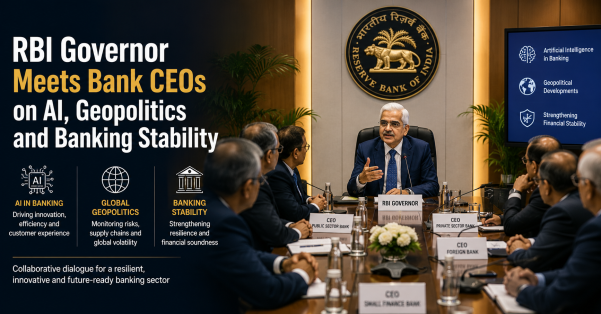
RBI Governor Meets Bank CEOs to Discuss AI, Geopolitics, and Banking Stability Amid Global Uncertainty
Reserve Bank of India (RBI) Governor Sanjay Malhotra held a high-level meeting with the managing directors and chief executive officers of public sector banks and select private sector lenders to review the evolving challenges facing India's banking sector. The discussions focused on the growing role of artificial intelligence (AI), geopolitical developments, cybersecurity, banking resilience, and regulatory priorities as financial institutions navigate an increasingly complex global environment.
The meeting comes at a time when banks are accelerating digital transformation while also managing risks arising from global economic uncertainty, technological disruption, and changing customer expectations.
AI Adoption Takes Centre Stage
Governor Malhotra encouraged banks to leverage advanced technologies, including AI, to improve operational efficiency, expand financial services, reduce costs, and enhance customer experience. At the same time, he stressed that AI deployment must be supported by robust cybersecurity measures, strong internal controls, and safeguards against fraud and misuse of customer data.
Banks are increasingly adopting AI across areas such as:
-
Customer service automation
-
Fraud detection
-
Credit risk assessment
-
Loan processing
-
Regulatory compliance
-
Data analytics
-
Personalized banking services
-
Operational efficiency
The RBI emphasized that technological innovation should strengthen banking resilience without compromising security or governance.
Geopolitical Risks Remain a Key Concern
The meeting also highlighted the impact of geopolitical developments on financial markets, capital flows, commodity prices, and overall banking stability. Global conflicts, supply chain disruptions, and volatile energy prices continue to create uncertainty for financial institutions and borrowers alike.
The central bank encouraged lenders to strengthen their risk management frameworks and remain vigilant against external shocks that could affect liquidity, asset quality, and market confidence.
Focus on Banking Stability
Governor Malhotra acknowledged the broad-based growth of India's banking sector while urging lenders to continue supporting all segments of the economy with prudence and sound risk management. Discussions also covered implementation of the Expected Credit Loss (ECL) framework, which aims to strengthen credit risk recognition and improve the resilience of bank balance sheets.
The RBI reaffirmed the importance of maintaining strong capital positions, effective governance, and disciplined lending practices as the financial sector evolves.
Cybersecurity and Digital Trust
With digital banking becoming increasingly important, cybersecurity remained a major discussion point. The Governor asked banks to strengthen their cyber resilience through enhanced monitoring, fraud prevention systems, secure digital infrastructure, and better protection of customer information.
As AI adoption accelerates, regulators are placing greater emphasis on responsible technology deployment and operational safeguards.
Other Regulatory Priorities
In addition to AI and geopolitical developments, the meeting covered several ongoing initiatives and regulatory topics, including:
-
Expected Credit Loss (ECL) implementation
-
Central KYC Registry (CKYCR)
-
Early detection of counterfeit currency
-
MuleHunter adoption for fraud prevention
-
Central Bank Digital Currency (CBDC)
-
Unified Lending Interface (ULI)
-
Account Aggregator framework
-
Foreign Currency Non-Resident (Bank) [FCNR(B)] deposits
-
Customer service improvements
-
Financial inclusion initiatives
These initiatives form part of the RBI's broader strategy to modernize India's banking ecosystem while strengthening resilience and improving customer outcomes.
What It Means for the Banking Industry
The discussions indicate that Indian banks are entering a phase where technology adoption, cybersecurity, and prudent risk management will be equally important. Financial institutions are expected to increase investments in AI-driven solutions while maintaining strong governance standards and regulatory compliance.
The RBI's focus on balancing innovation with stability reflects the growing importance of digital transformation in ensuring long-term competitiveness and financial resilience.
Conclusion
The RBI Governor's meeting with bank CEOs underscored the central bank's priorities of promoting responsible AI adoption, strengthening cybersecurity, managing geopolitical risks, and preserving financial stability. As India's banking sector continues to modernize, institutions will be expected to embrace technological innovation while maintaining sound governance, effective risk management, and customer trust.
The discussions also reaffirm the RBI's commitment to ensuring that the banking system remains resilient, well-capitalized, and prepared to navigate an increasingly dynamic global financial environment.