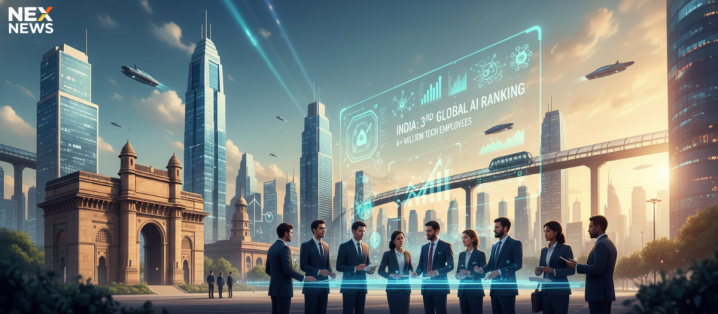
The artificial intelligence landscape is witnessing a significant shift, with India emerging as a major player. Ranking third globally in AI, the country is poised for substantial growth in the technology sector.
The technology sector is expected to see a substantial increase in revenue, projected to reach $300 billion by 2026. This growth is accompanied by an expanding ecosystem, with over 6 million employees.
This achievement underscores India's growing influence in the global AI landscape and highlights the country's potential for continued innovation and expansion in the tech industry.
Key Takeaways
- The country's AI ranking is a testament to its growing capabilities in the technology sector.
- Projected tech revenue is expected to reach $300 billion by 2026.
- The ecosystem is anticipated to support over 6 million employees.
- India's emergence in AI is a significant development in the global tech landscape.
- The growth in the tech sector is expected to drive further innovation.
India's Rising Position in the Global AI Landscape
The global AI landscape is witnessing a significant shift as India claims its third-place ranking, driven by innovation and technological advancements. This achievement is a testament to India's growing influence in the tech world.
Current Global AI Rankings and India's Achievement
India's third-place ranking in global AI rankings is a notable achievement, reflecting the country's substantial progress in artificial intelligence. The global AI landscape is dominated by a few key players, and India's emergence as a significant contributor is a result of its strategic investments in technology and talent development.
Key Factors Behind India's AI Success
Several factors have contributed to India's success in AI, including its vast talent pool and technical expertise. The country's ability to produce a large number of skilled professionals in AI and related fields has been a crucial factor.
Talent Pool and Technical Expertise
India's technical education system produces a large number of graduates in fields related to AI, such as computer science and engineering. This has created a robust talent pool that drives innovation in the AI sector.
Investment and Funding Environment
The investment and funding environment in India has also played a critical role in its AI success. Significant investments from both domestic and international investors have fueled the growth of AI startups and research initiatives.
These factors combined have propelled India to its current position in the global AI landscape, setting the stage for further growth and innovation in the field.
India 3rd in AI; tech revenue to hit $300B in 2026 with 6M+ employed
India's tech industry is on the cusp of a significant breakthrough, with revenue projected to hit $300 billion by 2026. This growth is a testament to India's rising position in the global AI landscape.
Breaking Down the Revenue Projections
The revenue projection of $300 billion by 2026 is not just a number; it represents a significant shift in the global tech landscape. Sector-wise revenue distribution will play a crucial role in this growth.
Sector-wise Revenue Distribution
The distribution of revenue across various sectors will be a key indicator of India's tech growth. Sectors such as software services, IT consulting, and digital services are expected to contribute significantly.
| Sector | Revenue Share (%) | Projected Revenue ($B) |
|---|---|---|
| Software Services | 40 | 120 |
| IT Consulting | 25 | 75 |
| Digital Services | 20 | 60 |
| Others | 15 | 45 |
Year-on-Year Growth Expectations
A steady year-on-year growth is expected, driven by increasing demand for tech services and innovative solutions.
Employment Growth Trends in the Tech Ecosystem
The employment landscape in India's tech ecosystem is also expected to witness significant growth, with projections indicating over 6 million employed in the sector by 2026.
Job Creation Across Experience Levels
Job creation will span across various experience levels, from entry-level positions to senior roles, indicating a robust and inclusive growth trajectory.
Regional Distribution of Tech Employment
The regional distribution of tech employment will continue to evolve, with major cities like Bengaluru, Hyderabad, and Pune remaining at the forefront.
| Region | Employment Share (%) | Number Employed (M) |
|---|---|---|
| Bengaluru | 30 | 1.8 |
| Hyderabad | 20 | 1.2 |
| Pune | 15 | 0.9 |
| Others | 35 | 2.1 |
The Evolution of India's Tech Ecosystem
The journey of India's technology sector is a story of rapid growth and innovation. Over the years, India has emerged as a significant player in the global tech landscape, driven by a combination of factors including a large talent pool, favorable government policies, and a growing demand for technology services.
Historical Growth Trajectory
India's tech journey began with a focus on IT services, catering primarily to international clients. The industry has since evolved, becoming a hub for innovation and technological advancements.
From IT Services to Innovation Hub
The transformation was fueled by investments in research and development, a growing startup ecosystem, and the emergence of new technologies. Today, India is not just an outsourcing hub but a breeding ground for tech innovation, with numerous incubators and accelerators supporting new ventures.
Transformation into an AI Powerhouse
India's tech ecosystem is now on the path to becoming an AI powerhouse. The country is making significant strides in adopting and developing artificial intelligence technologies.
Key Milestones in India's AI Journey
Several key milestones mark India's journey towards becoming an AI leader, including government initiatives to promote AI research, the establishment of AI-focused research centers, and collaborations with international tech giants. The future looks promising, with AI expected to play a crucial role in driving economic growth and technological advancement.
Key Drivers of India's Tech Revenue Growth
As India's technology sector continues to evolve, several key drivers are contributing to its revenue growth. The country's tech industry is experiencing a significant boost due to a combination of factors.
Domestic Market Expansion
The domestic market in India is expanding rapidly, driven by increasing digital adoption across various sectors. Digital transformation is becoming a priority for many Indian businesses, leading to a surge in demand for technology services and solutions. This trend is expected to continue, with the domestic market playing a crucial role in India's tech revenue growth.

Global Outsourcing and Service Exports
Global outsourcing and service exports are another significant driver of India's tech revenue growth. The country's IT services sector has been a major contributor to this growth, with many global companies outsourcing their technology needs to Indian firms. This trend is driven by India's skilled workforce, competitive pricing, and favorable business environment.
Product Innovation and IP Development
Product innovation and IP development are also crucial factors driving India's tech revenue growth. Indian companies are increasingly focusing on developing their own technology products and intellectual property, rather than just providing services. This shift is expected to drive revenue growth and help Indian companies become more competitive in the global market.
AI Sectors Fueling India's Technological Advancement
Artificial intelligence is emerging as a key driver of India's technological progress. The country's tech ecosystem is witnessing a significant transformation due to the integration of AI in various sectors.
Machine Learning and Data Analytics
Machine learning and data analytics are at the forefront of India's AI advancements. These technologies are being leveraged to gain insights from vast amounts of data, driving business decisions and innovation. Companies are adopting machine learning algorithms to predict market trends and enhance customer experiences.
Natural Language Processing and Voice Technologies
Natural Language Processing (NLP) and voice technologies are revolutionizing the way Indians interact with devices. NLP is being used in customer service chatbots, improving response times and efficiency. Voice technologies are also gaining traction, with applications in smart assistants and voice-controlled devices.
"The future of AI in India is not just about technology; it's about how we use it to create a more inclusive and sustainable society."
Computer Vision and Robotics
Computer vision and robotics are other critical areas where India is making significant strides. Computer vision is being applied in healthcare for image analysis and diagnostics, while robotics is enhancing manufacturing processes, improving precision, and reducing costs.
As these AI sectors continue to evolve, they are expected to drive further technological advancement in India, positioning the country as a global leader in the tech industry.
Government Initiatives Supporting AI and Tech Growth
The Indian government has launched several initiatives to boost the technology sector, recognizing its potential for driving economic growth. These initiatives are crucial for creating a conducive environment for artificial intelligence and tech development.
Digital India and Other National Programs
The Digital India program is a flagship initiative aimed at transforming the country into a digitally empowered society. It focuses on improving digital infrastructure, increasing digital literacy, and promoting the use of technology in governance. Other national programs, such as Make in India and Startup India, also contribute to the growth of the tech ecosystem by encouraging innovation and entrepreneurship.
Policy Frameworks and Regulatory Environment
The government has been working on creating a supportive policy framework to foster the growth of AI and technology. This includes:
- AI-specific Policies and Incentives: The government is formulating policies to encourage the adoption of AI and provide incentives for research and development in this field.
- Public-Private Partnerships: Collaboration between the government and private sector is being promoted to drive innovation and investment in AI and tech.
- These initiatives are expected to create a robust ecosystem that supports the growth of the technology sector, driving economic growth and positioning India as a global leader in AI and tech.
India vs Global Competitors: Comparative Analysis
With India now ranking 3rd in AI, understanding its standing relative to other major players is crucial. This section provides a comparative analysis of India's tech ecosystem against global competitors, focusing on key markets like the US and China.
Benchmarking Against the US and China
The US and China are currently the leaders in the global AI landscape. The US is renowned for its innovation and technological advancements, while China has made significant strides in AI research and deployment. India, now in third place, is rapidly closing the gap.
India's tech ecosystem has shown remarkable resilience and adaptability, allowing it to scale rapidly and compete with global giants. Key areas of comparison include the size of the tech workforce, the volume of tech exports, and the level of innovation.
Competitive Advantages of India's Tech Ecosystem
India's tech ecosystem boasts several competitive advantages that enable it to hold its ground against global competitors.
Cost Advantages and Value Proposition
One of the significant advantages India offers is cost-effectiveness. The cost of hiring tech talent in India is considerably lower compared to the US, making it an attractive destination for global companies looking to outsource or set up development centers.
Innovation and Research Capabilities
India is also making strides in innovation and research. With a growing number of startups and research institutions, India is becoming a hub for technological innovation, particularly in areas like AI, machine learning, and data analytics.
The combination of cost advantages, a robust talent pool, and increasing innovation capabilities positions India favorably in the global tech landscape. As the country continues to grow its tech ecosystem, it is well-placed to challenge the dominance of the US and China in the AI sector.
The 6 Million Strong: Workforce Dynamics in India's Tech Sector
A workforce of 6 million is set to catapult India's tech industry into the global spotlight, with significant implications for the economy. The technology sector is experiencing rapid growth, driven by an increasingly skilled workforce.
Skill Distribution and Specializations
The Indian tech industry is characterized by a diverse range of skills and specializations. AI and machine learning talent are in high demand, with many professionals holding expertise in these areas.
AI and Machine Learning Talent
India is home to a large pool of AI and machine learning professionals, with many working on cutting-edge projects. This talent is driving innovation in the tech sector.
Software Development and IT Services
Software development and IT services are also major areas of focus, with many companies providing a range of services to clients globally.
Education and Training Infrastructure
The education and training infrastructure in India is playing a crucial role in supporting the growth of the tech sector. University programs and industry certifications are helping to equip professionals with the necessary skills.
University Programs and Industry Certifications
Many universities in India are offering programs in tech-related fields, while industry certifications are providing professionals with specialized skills.
Upskilling and Reskilling Initiatives
Upskilling and reskilling initiatives are also underway, enabling professionals to stay up-to-date with the latest technologies and trends.

Challenges on the Path to $300B
India's ambitious goal of achieving $300B in tech revenue by 2026 is fraught with multiple obstacles. Despite the promising projections, several challenges need to be addressed to ensure this target is met.
Infrastructure and Resource Constraints
The growth of India's tech sector is contingent upon overcoming infrastructure and resource constraints. Two significant challenges in this area are:
- Digital Divide and Connectivity Issues: Ensuring equitable access to high-speed internet and digital resources across the country is crucial.
- Power and Computing Resources: The increasing demand for power and advanced computing resources necessitates investments in energy infrastructure and data centers.
Global Economic Uncertainties and Competition
India's tech growth is also influenced by global economic uncertainties and competition. Key factors include:
- Geopolitical Factors: Trade policies, geopolitical tensions, and regulatory changes in major economies can impact India's tech exports and foreign investments.
- Talent Retention and Brain Drain: Retaining top talent within the country is a significant challenge, as global companies often seek to recruit from India's skilled workforce.
Addressing these challenges will be pivotal in ensuring India's tech sector continues on its growth trajectory and achieves the $300B revenue milestone by 2026.
Economic Impact of Tech Growth on India's Future
As India's tech sector continues to expand, its economic implications are becoming increasingly significant. The technology sector is not only driving economic growth but also transforming the way India approaches various socio-economic challenges.
GDP Contribution and Economic Multiplier Effects
The tech industry is making a substantial contribution to India's GDP. With projections indicating that tech revenue will hit $300 billion by 2026, the sector is poised to be a major economic driver. The economic multiplier effects of this growth are also noteworthy, as they lead to increased consumption, investment, and job creation in other sectors. For instance, a thriving tech industry can stimulate the growth of related services such as real estate, hospitality, and retail.
Social and Regional Development Implications
Beyond its economic impact, the tech sector's growth has significant social and regional development implications. Two key areas where this is evident are job creation beyond traditional tech centers and digital inclusion and social equity.
Job Creation Beyond Tech Centers
The tech industry is creating employment opportunities not just in major tech hubs like Bangalore and Hyderabad but also in smaller cities and towns. This decentralization of job opportunities is helping to reduce regional disparities and promote more inclusive growth.
Digital Inclusion and Social Equity
The growth of the tech sector is also driving digital inclusion, with more Indians gaining access to digital services and technologies. This not only enhances social equity but also opens up new opportunities for education, healthcare, and financial services, particularly for underserved communities.
The overall impact of the tech sector's growth on India's future is multifaceted, driving both economic prosperity and social progress.
Conclusion: India's Tech Trajectory Beyond 2026
India's ascent to the third position in the global AI landscape is a testament to its burgeoning technology sector. With tech revenue projected to hit $300B by 2026, the country's economic growth is poised to receive a significant boost.
The employment of over 6 million individuals in the tech ecosystem underscores the sector's potential for driving social and regional development. As India continues to leverage its strengths in machine learning, data analytics, and other AI sectors, its competitive advantages are likely to propel it further in the global tech landscape.
Beyond 2026, India's tech trajectory is expected to be shaped by ongoing government initiatives, advancements in product innovation, and a growing focus on IP development. The country's ability to navigate challenges such as infrastructure constraints and global economic uncertainties will be crucial in sustaining its growth momentum.
As India looks to the future, its technology sector is set to play an increasingly pivotal role in driving economic growth, fostering innovation, and cementing its position as a global tech powerhouse.