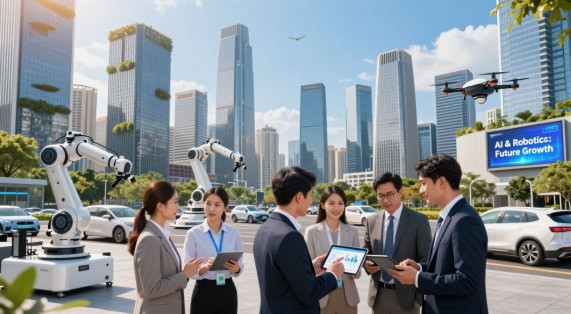
China's economic landscape is on the cusp of a significant transformation, driven by the integration of AI and robotics. According to a recent analysis by CICC, these technologies are poised to play a crucial role in boosting the country's long-term economic growth. This development is expected to have far-reaching implications for China's economic future.
The analysis highlights the potential of AI and robotics to drive growth, improve productivity, and enhance competitiveness. As a result, China's economy is anticipated to experience significant growth, driven by the adoption of these technologies.
Key Takeaways
- CICC analysis anticipates AI and robotics will boost China's long-term economic growth.
- The integration of these technologies is expected to improve productivity and competitiveness.
- China's economic future is likely to be shaped by the adoption of AI and robotics.
- The analysis highlights the potential for significant economic growth driven by technological advancements.
- AI and robotics are poised to play a crucial role in China's economic transformation.
CICC: AI and robotics to drive China's long-term economic growth
According to a recent analysis by CICC, AI and robotics are poised to significantly boost China's long-term economic growth. This development is expected to have far-reaching implications for China's economic landscape.
Overview of the groundbreaking CICC analysis
CICC's analysis provides a comprehensive overview of how AI and robotics are likely to impact China's economy. The report highlights several key areas where these technologies are expected to make a significant difference, including increased productivity, improved efficiency, and enhanced competitiveness.
The analysis underscores the potential of AI and robotics to drive growth across various sectors, from manufacturing to services. By leveraging these technologies, China aims to achieve sustainable economic growth and maintain its position as a global economic leader.
Key economic growth projections and timeline
CICC's research provides detailed projections for China's economic growth, driven by the adoption of AI and robotics. The key findings include:
- AI and robotics are expected to contribute significantly to China's GDP growth over the next two decades.
- The implementation of these technologies is projected to enhance productivity by improving manufacturing processes and reducing labor costs.
- China's economic growth is anticipated to be driven by the increased use of AI and robotics in various industries, leading to improved competitiveness.
The timeline for these projections indicates that the impact of AI and robotics will be felt in multiple phases, with significant growth expected between 2025 and 2040.
Methodology behind CICC's research findings
CICC's analysis is based on a robust methodology that incorporates data from various sources, including industry reports, academic research, and economic indicators. The research employed a combination of quantitative and qualitative methods to assess the potential impact of AI and robotics on China's economy.
The key aspects of the methodology include:
- Econometric modeling to forecast economic growth.
- Industry surveys to understand the adoption rates of AI and robotics.
- Analysis of policy initiatives and government support for AI and robotics development.
By using this comprehensive approach, CICC has provided a detailed and reliable assessment of the potential economic benefits of AI and robotics in China.
Current state of AI and robotics development in China
AI and robotics are transforming China's economy, with major research centers and innovation hubs emerging nationwide. This transformation is driven by significant investments in AI research and development, as well as the integration of robotics into various industries.
Major AI research initiatives and innovation centers
China has established several major AI research initiatives and innovation centers across the country. These centers are focused on advancing AI technology and applying it to various sectors.
Beijing and Shanghai AI hubs
Beijing and Shanghai have emerged as significant AI hubs in China. Beijing is home to the Beijing Academy of Artificial Intelligence (BAAI), which is a leading research institution in AI. Shanghai, on the other hand, has been focusing on developing its AI infrastructure and has attracted numerous AI startups.
Shenzhen's robotics ecosystem
Shenzhen has become a major hub for robotics in China, with a thriving ecosystem that includes manufacturers, suppliers, and research institutions. The city is known for its innovation in robotics and has produced several leading robotics companies.
Recent technological breakthroughs
China has made significant technological breakthroughs in AI and robotics in recent years. Some of the key advancements include:
- AI algorithms: Chinese researchers have made significant progress in developing advanced AI algorithms, including those related to deep learning and natural language processing.
- Robotics: There have been notable advancements in robotics, particularly in areas such as industrial automation and service robotics.
- Integration with other technologies: AI and robotics are being integrated with other technologies like the Internet of Things (IoT) and 5G, leading to the development of more sophisticated systems.
Current market size and growth trajectory
The market for AI and robotics in China is currently experiencing rapid growth. According to recent reports, the Chinese AI market was valued at several billion dollars in the previous year and is expected to continue growing at a significant rate over the next few years.
The growth trajectory is driven by increasing demand for automation, advancements in AI technology, and government support for the development of AI and robotics industries.
China's strategic investments in artificial intelligence
The Chinese government has been making significant investments in AI, aiming to boost its long-term economic growth. This strategic focus on AI is part of a broader effort to drive innovation and technological advancement across various sectors.
Government Funding Allocations and Policy Framework
The Chinese government has established a robust policy framework to support the development of AI. Government funding allocations have been significant, with a focus on promoting research and development in AI technologies. This includes investments in infrastructure, talent acquisition, and innovation hubs.
The policy framework is designed to create a conducive environment for AI development, with guidelines and incentives for both public and private sector entities. This comprehensive approach has been instrumental in driving China's AI ambitions forward.
China's New Generation AI Development Plan
A key component of China's AI strategy is the New Generation AI Development Plan, which outlines the country's vision for AI development until 2030. This plan emphasizes the need for breakthroughs in core AI technologies, the development of intelligent industries, and the creation of an AI-driven economy.
The plan also highlights the importance of international cooperation, talent cultivation, and the establishment of AI standards. By focusing on these areas, China aims to become a global leader in AI research and application.
Private Sector Participation and Venture Capital Trends
Private sector participation has been a crucial driver of China's AI development. Tech giants such as Alibaba, Tencent, and Baidu have made significant investments in AI research and development, driving innovation in areas like natural language processing, computer vision, and machine learning.
Tech Giants' AI Investments
These tech giants have not only invested heavily in AI research but have also established dedicated AI research labs and innovation centers. Their efforts have contributed significantly to China's AI ecosystem, fostering a culture of innovation and entrepreneurship.
Emerging AI Startups Landscape
The emergence of AI startups has further enriched China's AI landscape. Venture capital trends indicate a strong interest in AI startups, with significant funding being directed towards companies working on cutting-edge AI technologies.
This influx of capital has enabled startups to innovate and scale, contributing to the overall growth of China's AI sector. The combination of government support, private sector investment, and a thriving startup ecosystem positions China well for its AI ambitions.
Robotics revolution transforming Chinese manufacturing
Robotics is revolutionizing Chinese manufacturing, with significant implications for production processes and economic growth. The adoption of robotics and automation technologies is enhancing productivity, improving quality control, and driving efficiency across various manufacturing sectors.
Adoption Rates Across Sectors
The industrial automation adoption rates in China have been increasing steadily across different sectors. Automotive and electronics manufacturing are among the leading industries embracing robotics. According to recent data, the automotive sector has seen a significant rise in robotic integration, with many manufacturers adopting automated assembly lines.
- Automotive manufacturing: 35% increase in robotics adoption
- Electronics manufacturing: 28% increase
- Aerospace manufacturing: 22% increase
Case Studies of Successful Factory Transformations
Several Chinese factories have undergone successful transformations through the integration of robotics. For instance, a leading automotive manufacturer implemented a fully automated assembly line, resulting in a 30% increase in production efficiency. Another example is an electronics company that adopted robotic inspection systems, achieving a 25% reduction in defect rates.
Impact on Production Efficiency and Quality Control
The integration of robotics has significantly impacted production efficiency and quality control in Chinese manufacturing. Robotics has enabled manufacturers to achieve higher precision and consistency, reducing the likelihood of human error. This has led to improvements in product quality and reduced production costs.
- Improved precision and consistency
- Reduced labor costs
- Enhanced product quality
Smart Manufacturing Initiatives
China is also promoting smart manufacturing initiatives, which involve the integration of robotics, AI, and IoT technologies to create intelligent manufacturing systems. These initiatives aim to enhance manufacturing flexibility, improve supply chain management, and drive innovation.
The future of Chinese manufacturing looks promising, with robotics playing a crucial role in shaping the industry's growth and development.
Economic challenges AI and robotics aim to address
As China navigates its economic future, AI and robotics emerge as key solutions to pressing challenges. China's economic growth is heavily reliant on its ability to adapt to changing demographic and economic landscapes.
Demographic Pressures and Aging Workforce Solutions
China is facing significant demographic challenges, including an aging population and a shrinking workforce. AI and robotics can help mitigate these issues by automating tasks and enhancing productivity.
The impact of an aging workforce is substantial, with labor shortages becoming increasingly common in various sectors. By adopting automation technologies, China can reduce its reliance on manual labor and maintain economic momentum.
Labor Cost Increases and Competitiveness Concerns
Rising labor costs in China have raised concerns about the country's competitiveness in the global market. Implementing AI-driven automation can help reduce labor costs and enhance competitiveness.
| Sector | Labor Cost Increase | Automation Potential |
|---|---|---|
| Manufacturing | 15% | High |
| Services | 10% | Medium |
| Agriculture | 8% | Low-Medium |
Productivity Enhancement Requirements
Enhancing productivity is crucial for sustaining economic growth. AI and robotics can significantly boost productivity by optimizing processes and reducing inefficiencies.
For instance, in the manufacturing sector, robotic process automation can streamline production lines, leading to increased output and reduced costs.
Supply Chain Resilience through Automation
Supply chain disruptions can have significant economic impacts. By integrating AI and automation, companies can enhance supply chain resilience and reduce the risk of disruptions.
Automation technologies can help in predicting and mitigating supply chain risks, ensuring a smoother flow of goods and services.
Industry-specific impacts of AI and robotics integration
As AI technology in China continues to advance, its impact is being felt across multiple industries, from manufacturing to finance. The integration of AI and robotics is driving significant changes in various sectors, enhancing productivity, and creating new opportunities.
Manufacturing Sector Transformation
The manufacturing sector is one of the primary beneficiaries of AI and robotics integration. Industrial automation is increasing efficiency and reducing labor costs. Companies are adopting smart manufacturing practices, which involve the use of AI-powered machines and robots to improve production processes.
| Sector | AI/Robotics Application | Impact |
|---|---|---|
| Manufacturing | Industrial Automation | Increased Efficiency |
| Healthcare | Medical Diagnosis Assistance | Improved Accuracy |
| Financial Services | Risk Management and Fraud Detection | Enhanced Security |
Healthcare and Biotech Applications
In healthcare, AI is being used for medical diagnosis assistance, helping doctors identify diseases more accurately. Robotics is also being applied in surgeries, enhancing precision and reducing recovery times.

Financial Services and Fintech Innovation
The financial sector is experiencing significant innovation due to AI and robotics. Risk management and fraud detection systems are being implemented to enhance security and protect customer data.
Agriculture and Food Production Automation
AI and robotics are also transforming agriculture by introducing precision farming techniques. Autonomous tractors and drones are being used to monitor crop health and optimize yields.
Retail and Consumer Services Disruption
In retail, AI-powered chatbots and customer service robots are improving customer experience. Personalized marketing is also being driven by AI algorithms that analyze consumer behavior.
The integration of AI and robotics across these industries is not only enhancing efficiency but also creating new business models and opportunities for growth.
Projected timeline for AI and robotics economic contributions
The integration of AI and robotics is expected to play a crucial role in China's long-term economic growth. As per CICC's analysis, the timeline for these contributions can be broken down into three distinct phases: short-term, medium-term, and long-term.
Short-term economic effects (2023-2028)
In the short term, AI and robotics are anticipated to enhance productivity and efficiency across various sectors. Initial investments in AI and robotics technologies are expected to drive growth, particularly in manufacturing and services. The adoption of automation technologies will lead to improved production processes and reduced labor costs.
Medium-term structural changes (2028-2035)
As AI and robotics technologies mature, they are expected to induce significant structural changes in the economy. The medium term will see increased adoption of smart manufacturing practices, leading to enhanced product quality and reduced production times. Additionally, AI-driven analytics will become more prevalent, enabling businesses to make data-driven decisions.
Long-term economic transformation (2035-2050)
In the long term, AI and robotics are projected to drive a fundamental transformation in China's economy. The widespread adoption of these technologies is expected to lead to the creation of new industries and job categories, offsetting potential job losses due to automation. Furthermore, AI and robotics will contribute to the development of a more efficient and resilient supply chain.
GDP growth attribution models
CICC's analysis employs sophisticated GDP growth attribution models to quantify the economic contributions of AI and robotics. These models consider various factors, including productivity gains, investment in AI and robotics technologies, and the overall impact on the economy. According to these models, AI and robotics are expected to contribute significantly to China's GDP growth over the coming decades.
The CICC report highlights that the economic benefits of AI and robotics will not be limited to GDP growth alone. These technologies are also expected to drive innovation, improve competitiveness, and enhance the overall quality of life in China.
China's position in the global AI and robotics landscape
China's strategic investments in AI and robotics are redefining its standing in the global tech arena. As the country continues to make significant strides in these technologies, it's essential to assess its position relative to other global leaders.
Comparative Analysis with United States Capabilities
The United States and China are often considered the frontrunners in the AI and robotics race. While the U.S. has traditionally held a strong position in AI research and development, China's rapid advancements are closing the gap. According to a report by the Center for Strategic and International Studies, "China has made significant investments in AI, with a focus on developing a comprehensive AI ecosystem." This includes substantial investments in research and development, as well as the development of AI-related infrastructure.
A comparative analysis reveals that while the U.S. leads in certain areas such as AI research publications and top AI talent, China is rapidly catching up. China's focus on applying AI in real-world scenarios, such as in manufacturing and surveillance, has given it a practical edge.

Competition with Other Asian Technology Powers
China is not alone in its pursuit of AI and robotics dominance; other Asian countries are also making significant strides. South Korea and Japan, in particular, are noteworthy competitors.
South Korea's Robotics Advancement
South Korea has been focusing on robotics, with a particular emphasis on developing robots for service and manufacturing sectors. The country's robotics industry is expected to grow significantly, driven by government support and investments in automation technologies.
Japan's Automation Expertise
Japan, known for its automation expertise, continues to be a leader in robotics. Japanese companies are at the forefront of developing advanced robotic systems for manufacturing and healthcare. Japan's focus on precision and quality has enabled its robotics industry to thrive globally.
International Collaborations and Knowledge Exchange
Despite the competitive landscape, there is a growing trend towards international collaborations in AI and robotics. China has been actively engaging in global partnerships to advance its AI capabilities. For instance,
"Chinese tech giants like Alibaba and Tencent have been collaborating with international universities and research institutions to develop cutting-edge AI technologies."
Such collaborations not only facilitate the exchange of knowledge but also accelerate the development of AI and robotics.
These international collaborations are crucial for China's AI strategy, enabling it to stay abreast of global advancements and leverage international expertise.
Implications for India-China economic dynamics
As China continues to invest heavily in AI and robotics, the implications for India-China economic relations are becoming increasingly significant. The advancements in these technologies are not only transforming China's economic landscape but also have far-reaching consequences for India's technology sector and bilateral trade dynamics.
Competitive Challenges for Indian Technology Sector
The rapid growth of China's AI and robotics industries poses significant competitive challenges for India's technology sector. Indian companies must innovate and adapt quickly to remain competitive in a landscape where Chinese firms are increasingly leveraging advanced technologies to drive efficiency and innovation.
Key areas of competition include:
- Development of AI-powered solutions
- Robotics and automation technologies
- Integration of AI in manufacturing and services
Collaborative Opportunities in AI Research
Despite the competitive challenges, there are significant opportunities for collaboration between India and China in AI research. Collaborative research initiatives could focus on areas such as healthcare, agriculture, and smart cities, where both countries have complementary strengths and shared interests.
Potential collaboration areas:
- AI applications in healthcare
- Smart agriculture technologies
- AI-driven urban planning
Knowledge Transfer Potential Between Nations
The potential for knowledge transfer between India and China in AI and robotics is substantial. Indian researchers and companies can benefit from China's advancements in areas like computer vision and natural language processing, while China can learn from India's expertise in software development and IT services.
| Area of Expertise | India's Strengths | China's Strengths |
|---|---|---|
| AI Applications | Software development, IT services | Computer vision, NLP |
| Robotics | Automation solutions | Manufacturing, hardware development |
Impact on Bilateral Trade in Technology Products
The advancements in AI and robotics are likely to have a significant impact on bilateral trade in technology products between India and China. As both countries develop their technological capabilities, there may be increased trade opportunities, but also potential areas of competition.
Strategic Considerations for Indian Policymakers
Indian policymakers must consider several strategic factors to navigate the implications of China's AI and robotics advancements. These include investing in AI research and development, fostering collaboration between Indian and Chinese companies, and developing policies to support the growth of India's technology sector.
Key policy considerations:
- Enhancing AI research funding
- Promoting international collaborations
- Developing talent in emerging technologies
Conclusion: The future economic landscape shaped by AI and robotics in China
China's strategic investments in artificial intelligence and robotics are poised to drive significant long-term economic growth, transforming the country's economic landscape. The integration of these technologies is expected to enhance productivity, improve efficiency, and foster innovation, ultimately contributing to China's emergence as a global economic powerhouse.
The robotics economy in China is anticipated to play a crucial role in addressing demographic pressures, labor cost increases, and productivity enhancement requirements. As China's innovation in AI continues to advance, the country is likely to experience substantial economic benefits, including improved manufacturing processes, enhanced healthcare services, and increased competitiveness in the global market.
As the Chinese economy continues to evolve, driven by the adoption of AI and robotics, it is essential for stakeholders to understand the implications of these technologies on the future economic landscape. By leveraging these advancements, China can achieve sustained long-term economic growth, solidifying its position as a major player in the global economy.